Numbers from this site's public API on a 4-card $25,000 portfolio at 16-24% APR. Open the calculator with your own balances and rates and the same numbers come out in real time.
The example portfolio
$25,000 is the size where the minimum payments alone come to $625 a month. This page uses four US credit cards — the same four-card shape and the same 24 / 22 / 19 / 16 APR ladder as the $25K in 1 year case study. Card A carries $9,000 at 24% APR with a $225 minimum; Card B $7,000 at 22% with a $175 minimum; Card C $5,000 at 19% with a $125 minimum; Card D $4,000 at 16% with a $100 minimum. The four minimums add up to $625 a month, and each one is exactly 2.5% of its own balance.
The rates run a ladder from 24% down to 16%, and the largest balance carries the highest rate. Weighted by balance, the portfolio's rate is 21.16% a year: $9,000 × 24%, $7,000 × 22%, $5,000 × 19% and $4,000 × 16% come to $5,290.00 of annual interest on a $25,000 balance. One twelfth of that is 1.76333%, which on the opening balance is $440.83 for the first month — $180.00 on Card A, $128.33 on Card B, $79.17 on Card C and $53.33 on Card D.
To clear all four in twenty-four months, the snowball method needs $1,495 a month, which is $870 above the minimums. Avalanche needs less — $1,451 — because it goes straight at the 24% card. Every figure on this page is for the snowball plan unless it says otherwise.
The $870 that never changes
Most payoff pages describe the snowball as something that grows: you kill the smallest card and the money that was paying it rolls onto the next one. On a fixed deadline that is not what happens. The plan holds $870 of new money above the minimums, so the total payment is just $870 plus the minimums you still owe — and it falls every time a card closes.
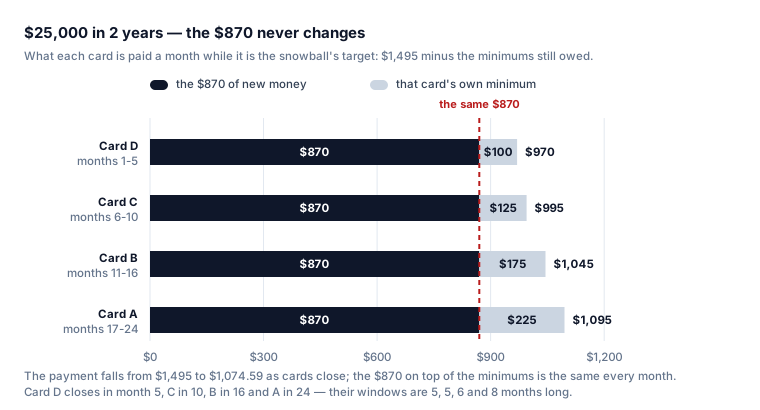
That gives the whole two years away in four numbers. While all four cards are open the payment is $870 + $625 = $1,495. Card D closes in month 5 and its $100 minimum stops, so months 6 to 10 are $870 + $525 = $1,395. Card C closes in month 10 and its $125 goes, so months 11 to 16 are $870 + $400 = $1,270. Card B closes in month 16 and its $175 goes, so months 17 to 24 are $870 + $225 = $1,095. Card A's own $225 never drops, because the plan ends in the same month Card A does.
So the money aimed at the snowball's target is $870 plus that card's own minimum, and nothing else: Card D gets $970 a month, Card C $995, Card B $1,045, Card A $1,095. The extra is $870 in all four cases. That is why the four cards close in months 5, 10, 16 and 24 — windows of 5, 5, 6 and 8 months that stretch rather than shrink. The snowball does not accelerate here; the balances it is aimed at get bigger while the money going at them barely moves.
| The card | Its window | Its minimum | Paid as the target | Cleared |
|---|---|---|---|---|
| Card D — $4,000 at 16% | months 1-5 | $100 | $970 | month 5 |
| Card C — $5,000 at 19% | months 6-10 | $125 | $995 | month 10 |
| Card B — $7,000 at 22% | months 11-16 | $175 | $1,045 | month 16 |
| Card A — $9,000 at 24% | months 17-24 | $225 | $1,095 | month 24 |
Read the third and fourth columns together and the mechanism is the whole story: the smallest card is the cheapest to clear but also gets the least money, and the largest card gets the most money but only for the last eight months. Twenty-three of the plan's twenty-four payments are one of those four steps; only the last one is not, and that is because the balance runs out partway through month 24.
What the two years cost
The twenty-four months cost $5,809.59 of interest, and the total that leaves your account is $30,809.59. The interest is 23.24% of the balance you started with and 18.86% of everything you send. The whole two years of interest is 9.295 of the $625 minimum payments, and the monthly charge falls from $440.83 in month 1 to $21.07 in month 24 — 20.92 times less. By the last payment, 98.04% of the $1,074.59 reaches principal and only 1.96% is interest.
Avalanche is cheaper and faster on this portfolio. Run at the same $1,495 a month it is charged $4,841.48 — $968.11 less, so the snowball bill is 1.200 times the avalanche bill — and it finishes in month 23, a month before the snowball. Avalanche can also clear the balance at its own lower threshold of $1,451, and at that smaller payment it lands in twenty-four months for $5,047.81; the $4,841.48 above is the equal-payment figure, so the two numbers differ by the payment they are measured at, not by the method.
The payments step down three times as cards close: $1,495 in months 1 to 5, $1,395 in months 6 to 10, $1,270 in months 11 to 16, $1,095 in months 17 to 23, and $1,074.59 in month 24. Each drop is exactly the minimum of the card that just cleared — $100 for Card D, $125 for Card C, $175 for Card B — and the fourth drop, Card A's $225, never arrives: the plan ends at $1,074.59 instead of $1,095. The balance path is $23,945.83, $22,876.96, $21,793.18, $20,694.28, $19,580.04, $18,548.47, $17,500.24, $16,435.07, $15,352.69, $14,252.81, $13,258.29, $12,245.45, $11,213.94, $10,163.43, $9,093.56, $8,003.98, $7,069.06, $6,115.44, $5,142.75, $4,150.61, $3,138.62, $2,106.39, $1,053.52 and zero.
The deadline itself is exact. $1,495 a month lands the payoff in twenty-four months; $1,494 adds a twenty-fifth and takes the interest to $5,815.72. Avalanche's own deadline sits lower: $1,451 finishes in twenty-four months, and $1,450 pushes it to twenty-five and $5,053.13. The first twelve months send $16,990.00 and the last twelve $13,819.59 — 18.66% less — and they retire $12,754.55 against $12,245.45. Twenty-four flat payments of $1,495 would come to $35,880; the plan sends $30,809.59, so $5,070.41 of those flat payments never happens.
Where the $870 comes from
This is the part that decides whether the plan happens, so it is worth stating plainly: you need $870 a month above the $625 you already pay — 1.392 times the minimums — and over the twenty-four months the new money alone is $20,880, which is 83.52% of the balance. The plan pays 2.392 times the minimums and finishes the job in 24 months instead of 81 — 3.375 times faster.
Two comparisons make the size of the ask concrete. The plan's $30,809.59 is 68.90% of the $44,718.70 the minimums-only path costs, so you spend about two thirds of the money and save $13,909.11. And month 1 of the minimums is charged the same $440.83 the plan is, but of that $625 only $184.17 reaches principal — 29.47%, against 70.51% for the plan's first payment.
Stretching the same $25,000 across different deadlines is a separate trade, and it is worth naming. The six-month plan on this portfolio is $4,643 a month and $1,632.97 of interest; the twelve-month plan is $2,543 a month and $3,033.29; the twenty-four-month plan is $1,495 a month and $5,809.59; the thirty-six-month plan is $1,140 a month and $8,566.62. Going from one year to two cuts the payment by $1,048 a month and adds $2,776.30 of interest, which is 91.5% of the twelve-month bill. You are buying cash flow, and you are paying for it in interest.
Card by card, the plan is charged $3,496.84 on Card A, $1,610.09 on Card B, $559.86 on Card C and $142.80 on Card D. Card A is 36.00% of the balance but 60.19% of the plan's interest bill, which is why paying it first is the whole of the avalanche advantage. On the minimums-only path the same four cards are charged $9,265.04, $5,720.49, $2,978.94 and $1,754.24, and they clear in months 58, 64, 73 and 81.
Reproduce these numbers
Every figure on this page comes from this site's public API. Post the four balances, their rates, their minimums and extra: 870 to /api/payoff and you get the same months, the same $5,809.59 and the same per-card breakdown — including the remaining on each month of the timeline, once with extra: 870 and once with extra: 0. Two things that trip people up: APR goes in as a percentage (24, not 0.24), and extra is the amount above your total minimums, not your total payment — $870 here, which is what turns the $625 in minimums into $1,495 a month. Or just open the calculator and type your balances in — same engine, no payload.
If your target is a different size or a different deadline, the same analysis is in the $25K in 1 year, $30K in 2 years, $30K in 1 year, $30K in 6 months, $40K in 2 years, $40K in 1 year, $40K in 6 months, $80K in 2 years, $80K in 12 months, $80K in 6 months, $70K in 2 years, $70K in 12 months, $70K in 6 months, $60K in 2 years, $60K in 12 months, $60K in 6 months, $50K in 2 years, $50K in 12 months, $50K in 6 months, $20K in 1 year, $20K in 6 months, $15K in 1 year, $15K in 6 months, $10K, $10K in 6 months, $5K in 1 year, $5K in 6 months and $100K case studies, plus a 36-second walkthrough of the $25K case on YouTube. Shorter answers to the most common payoff questions live in the payoff questions hub.
Frequently asked
How much do I have to pay a month to clear $25,000 in two years?
On the four-card example here, $1,495 a month clears the $25,000 in twenty-four months on the snowball method, which is $870 above the $625 in minimums. Avalanche needs less — $1,451 — because it goes at the 24% card first.
How much interest does $25,000 cost over two years?
The snowball plan is charged $5,809.59 and the total that leaves your account is $30,809.59 — the $25,000 balance plus that interest. The interest is 23.24% of the balance you started with and 18.86% of everything you send, and it is 9.295 of the $625 minimum payments. Run at the same $1,495 a month, avalanche is charged $4,841.48, which is $968.11 less — 1.200 times the avalanche bill — and it finishes a month earlier, in month 23.
Why is every payment the same $870 plus the minimums?
Because that is how a fixed deadline works. The plan holds $870 of new money on top of the minimums, so the total payment is $1,495 while all four cards are open, $1,395 once Card D closes and its $100 minimum stops, $1,270 once Card C's $125 goes, and $1,095 once Card B's $175 goes. Card A's $225 never drops, because the plan ends the same month Card A does. The consequence is that the snowball never grows: whichever card is the target is paid $870 plus its own minimum — $970, then $995, then $1,045, then $1,095.
Does it matter which card I pay off first on a two-year plan?
It is worth $968.11 at the same $1,495 a month, and it is also worth a month: avalanche finishes in month 23 where the snowball needs 24. Snowball clears Card D in month 5, Card C in month 10, Card B in month 16 and Card A in month 24; avalanche clears Card A in month 10, Card B in month 16, Card C in month 20 and Card D in month 23. Card A is 36.00% of the balance but 60.19% of the snowball interest bill — $3,496.84 of the $5,809.59.
What if I only pay the minimums on $25,000?
The $625 in minimums clears the balance in 81 months and costs $19,718.70 in interest, a total bill of $44,718.70. The twenty-four-month plan is charged $5,809.59, a saving of $13,909.11. The plan also finishes 3.375 times faster: 24 months against 81. Month 1 of the minimums is charged the same $440.83 the plan is, but only $184.17 of that $625 reaches principal, against $1,054.17 of the plan's first payment. The four cards clear in months 58, 64, 73 and 81 — Card A alone runs the last 8.
How long does it take to pay off $25,000 in 2 years?
Two years, by definition — but only if you send $1,495 a month, which is 2.392 times the $625 in minimums. The deadline is exact: $1,495 lands the payoff in twenty-four months and $1,494 adds a twenty-fifth. Avalanche's own deadline sits lower, at $1,451, and $1,450 pushes it to twenty-five months. The minimums alone take 81 months on the same portfolio and cost $19,718.70 in interest.
What is the blended interest rate on this portfolio?
21.16% a year, weighted by balance: $9,000 at 24%, $7,000 at 22%, $5,000 at 19% and $4,000 at 16% work out to $5,290.00 of annual interest on $25,000. One twelfth of that is 1.76333%, which is $440.83 on the opening balance — $180.00 on Card A, $128.33 on Card B, $79.17 on Card C and $53.33 on Card D. By month 24, under the plan, the monthly interest is down to $21.07 — 20.92 times less than month 1.
What happens in the last month of the plan?
Month 24 is the only payment that is not a round step. The plan's twenty-three full payments are $1,495, $1,395, $1,270 and $1,095, and the last one is $1,074.59, because the balance runs out partway through the month — Card A's $225 minimum would have taken the payment to $1,095, and $20.41 of that is never needed. Of that final $1,074.59, $1,053.52 reaches principal and $21.07 is interest, which is 1.96% of the payment against 29.49% in month 1.