Numbers from this site's public API on a 5-card $80,000 portfolio at 15-25% APR. Open the calculator with your own balances and rates and the same numbers come out in real time.
The example portfolio
$80,000 is the size where the minimum payments alone cross $2,000 a month. This page uses five US credit cards — the same five-card shape and the same 25 / 22 / 20 / 17 / 15 APR ladder as the $60K and $70K six-month case studies, scaled to $80,000. Card A carries $25,000 at 25% APR with a $625 minimum; Card B $18,000 at 22% with a $450 minimum; Card C $16,000 at 20% with a $400 minimum; Card D $13,000 at 17% with a $325 minimum; Card E $8,000 at 15% with a $200 minimum. Every minimum is exactly 2.5% of its balance, and the five of them add up to $2,000 a month.
The rates run from 25% down to 15%, and the largest balance carries the highest rate. Weighted by balance, the portfolio's rate is 21.025% a year: $25,000 × 25%, $18,000 × 22%, $16,000 × 20%, $13,000 × 17% and $8,000 × 15% come to $16,820.00 of annual interest on an $80,000 balance. One twelfth of that is 1.7521%, which on the opening balance is $1,401.67 for the first month — $520.83 on Card A, $330.00 on Card B, $266.67 on Card C, $184.17 on Card D and $100.00 on Card E.
To clear all five in six months, the snowball method needs $14,868 a month, which is $12,868 above the minimums. Avalanche needs less — $14,723 — because it goes straight at the 25% card. Every figure on this page is for the snowball plan unless it says otherwise.
The payment falls; the debt does not
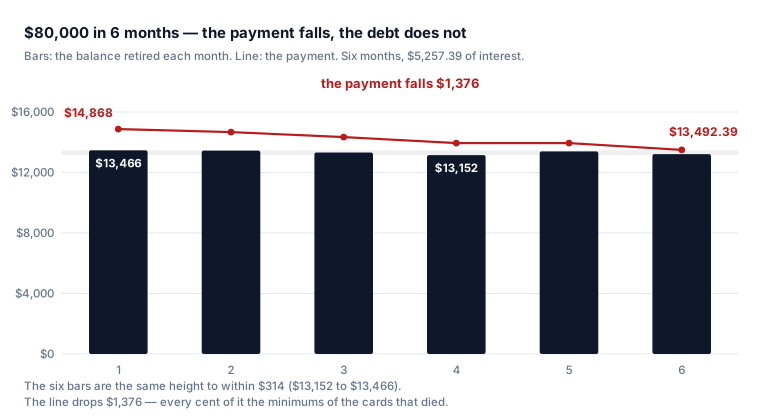
A six-month plan sounds like six of the same payment. It is not: the payments are $14,868, $14,668, $14,343, $13,943, $13,943 and $13,492.39, and the first is 9.25% bigger than the last. But look at what those six payments actually retire: $13,466.33, $13,445.30, $13,325.31, $13,152.31, $13,393.71 and $13,217.04. The biggest month and the smallest month are $314.02 apart — 2.33%. The payment falls 9.25%; the work falls 2.33%.
The reason is that only one of the two pieces inside the payment moves. The $12,868 of new money is the same in every one of the six months. What changes is the floor underneath it: the minimums you still owe on the cards that are still open. All five are open in month 1, so the floor is $2,000; Card E is gone by month 2, so it is $1,800; Card D by month 3, $1,475; Card C by month 4, $1,075, and it stays there in month 5; Card B is gone by month 6, so it is $625. The floor falls $1,375 from first to last, and the payment falls $1,375.61 — so 99.96% of the fall in your payment is minimums you no longer owe. The last $0.61 is the balance running out: month 6 would have been $13,493 on the pattern, and it is $13,492.39.
So the honest way to read the schedule is not "the payment is going down". It is "the debt is going down by $13,300 a month, six times, and the payment is only reporting which minimums you have finished paying". The payment goes from 18.58% of the balance in month 1 to 102.08% of it in month 6, but that is arithmetic, not progress — the progress is six bites of almost exactly the same size.
| The month | The payment | The balance retired | Minimums still owed |
|---|---|---|---|
| Month 1 | $14,868.00 | $13,466.33 | $2,000 |
| Month 2 | $14,668.00 | $13,445.30 | $1,800 |
| Month 3 | $14,343.00 | $13,325.31 | $1,475 |
| Month 4 | $13,943.00 | $13,152.31 | $1,075 |
| Month 5 | $13,943.00 | $13,393.71 | $1,075 |
| Month 6 | $13,492.39 | $13,217.04 | $625 |
| The six months | $85,257.39 | $80,000.00 | $2,000 down to $625 |
Read the middle column against the first one and the schedule stops being a puzzle. The payment drops $1,375.61 from month 1 to month 6; the balance retired moves inside a $314.02 band. A falling payment on a debt that is coming down at a constant rate is not a slowing plan — it is the same plan with fewer minimums left to carry.
What the six months cost
The six months cost $5,257.39 of interest, and the total that leaves your account is $85,257.39 — the $80,000 balance plus that interest. The interest is 6.57% of the balance you started with and 6.17% of everything you send. That is what paying this fast buys: the whole six months of interest is 2.63 of the $2,000 minimum payments, and the monthly charge falls from $1,401.67 in month 1 to $275.35 in month 6.
Snowball is not the cheapest way to spend those six months. Avalanche, run at the same $14,868 a month, is charged $4,495.83 — $761.56 less, which is 14.49% of the snowball interest bill — and it also finishes in six months. Avalanche can also clear the balance at its own lower threshold of $14,723, and at that smaller payment it costs $4,532.94; the $4,495.83 above is the equal-payment figure, so the two numbers differ by the payment they are measured at, not by the method. What the method changes is the order the cards leave in: snowball clears Card E in month 1, Card D in month 2, Card C in month 3, Card B in month 5 and Card A in month 6, while avalanche clears Card A in month 2, Card B in month 4, Card C in month 5, and Cards D and E together in month 6. Avalanche kills the 25% card in month 2; snowball kills it last.
The deadline itself is exact. $14,868 a month lands the payoff in six months; $14,867 leaves $5.68 standing after six months and takes a seventh. The balance path is $66,533.67, $53,088.37, $39,763.06, $26,610.75, $13,217.04 and zero. In month 1, 90.57% of what you send reaches principal; in month 6 it is 97.96%, because there is so little interest left to charge.
Where the $12,868 comes from
This is the part that decides whether the plan happens, so it is worth stating plainly: you need $12,868 a month above the $2,000 you already pay — 6.43 times the minimums — and over the six months the new money alone is $77,208, which is 96.51% of the balance. The plan pays 7.43 times the minimums and finishes the job in 6 months instead of 87 — 14.50 times faster.
Two comparisons make the size of the ask concrete. The whole six-month plan, at $85,257.39, is 59.20% of the $144,021.79 the minimums-only path would cost over 87 months: about three-fifths of the money, in a fourteenth of the time. And what the minimums do in those same six months is worth reading against the plan. They move $12,000 out of your account, of which $8,259.06 is interest and only $3,740.94 reaches principal — 31.17% of what you sent — and they leave $76,259.06 still owed, which is 95.32% of the original balance. The plan, over the same six months, sends $85,257.39 and ends at zero. Month 1 of the minimums is charged the same $1,401.67 the plan is, but of that $2,000 only $598.33 reaches principal — 29.92%, against 90.57% for the plan's first payment.
Reproduce these numbers
Every figure on this page comes from this site's public API. Post the five balances, their rates, their minimums and extra: 12868 to /api/payoff and you get the same months, the same $5,257.39 and the same per-card breakdown. Two things that trip people up: APR goes in as a percentage (25, not 0.25), and extra is the amount above your total minimums, not your total payment — $12,868 here, which is what turns the $2,000 in minimums into $14,868 a month. Or just open the calculator and type your balances in — same engine, no payload.
If your target is a different size or a different deadline, the same analysis is in the $70K in 6 months, $70K in 12 months, $60K in 6 months, $60K in 12 months, $60K in 2 years, $50K in 6 months, $50K in 12 months, $50K in 2 years, $40K in 1 year, $40K in 6 months, $30K in 6 months, $20K in 6 months, $15K in 6 months, $10K in 6 months, $5K in 6 months, $5K in 1 year, $10K, $15K, $20K, $25K, $30K and $100K case studies, plus a 36-second walkthrough of the $25K case on YouTube. Shorter answers to the most common payoff questions live in the payoff questions hub.
Frequently asked
How much do I have to pay a month to clear $80,000 in six months?
On the five-card example here, $14,868 a month clears the $80,000 in six months on the snowball method, which is $12,868 above the $2,000 in minimums. Avalanche needs less — $14,723 — because it goes at the 25% card first.
How much interest do I pay on $80,000 over six months?
The snowball plan is charged $5,257.39 and the total that leaves your account is $85,257.39 — the $80,000 balance plus that interest. The interest is 6.57% of the balance you started with and 6.17% of everything you send, and it is 2.63 of the $2,000 minimum payments. Run at the same $14,868 a month, avalanche is charged $4,495.83, which is $761.56 less — 14.49% of the snowball interest bill.
Why does the payment fall from month 1 to month 6?
Because only one of the two pieces inside it moves. The $12,868 of new money is identical in all six months; the floor underneath it is the sum of the minimums still owed on the cards that are still open. It is $2,000 while all five are open, $1,800 once Card E is gone, $1,475 once Card D is gone, $1,075 once Card C is gone and $625 for the last month with only Card A left. That turns into payments of $14,868, $14,668, $14,343, $13,943, $13,943 and $13,492.39. The floor falls $1,375 and the payment falls $1,375.61, so 99.96% of the fall in your payment is minimums you no longer owe; the last $0.61 is the balance running out, because month 6 would have been $13,493 on the pattern.
Does the debt fall as fast as the payment does?
No, and that is the point. The payment falls 9.25% from $14,868 to $13,492.39, but the balance retired is $13,466.33, $13,445.30, $13,325.31, $13,152.31, $13,393.71 and $13,217.04 — a spread of $314.02, or 2.33%. The six months are six bites of almost exactly the same size, and the payment is only reporting which minimums you have finished paying. It goes from 18.58% of the balance in month 1 to 102.08% of it in month 6, but the work does not change.
Does snowball versus avalanche matter on $80,000 over six months?
It is worth $761.56, which is 14.49% of the snowball interest bill. Both figures are for the same $14,868 a month: snowball takes 6 months and pays $5,257.39, avalanche takes 6 months and pays $4,495.83. Avalanche can also clear the balance at its own lower threshold of $14,723, and at that smaller payment it costs $4,532.94 — a different payment, not a different answer. The payoff orders differ: snowball clears Card E in month 1, Card D in month 2, Card C in month 3, Card B in month 5 and Card A in month 6, while avalanche clears Card A in month 2, Card B in month 4, Card C in month 5, and Cards D and E together in month 6. Avalanche kills the 25% card in month 2; snowball kills it last.
What if I only pay the minimums on $80,000?
The $2,000 in minimums clears the balance in 87 months — more than seven years — and costs $64,021.79 in interest, a total bill of $144,021.79. The six-month plan is charged $5,257.39, a saving of $58,764.40. The plan also finishes 14.50 times faster: 6 months against 87. Month 1 of the minimums is charged the same $1,401.67 the plan is, but only $598.33 of that $2,000 reaches principal, against $13,466.33 of the plan's first payment.
What do six months of the minimums actually retire?
Six months of minimums moves $12,000 out of your account. Of that, $8,259.06 is interest and only $3,740.94 reaches principal — 31.17% of what you sent — so after six months you still owe $76,259.06, which is 95.32% of the balance you started with. The plan, over the same six months, sends $85,257.39 and ends at zero.
What is the blended interest rate on this portfolio?
21.025% a year, weighted by balance: $25,000 at 25%, $18,000 at 22%, $16,000 at 20%, $13,000 at 17% and $8,000 at 15% work out to $16,820.00 of annual interest on $80,000. One twelfth of that is 1.7521%, which is $1,401.67 on the opening balance — and $1,401.67 divided by $80,000 is exactly 21.025% divided by twelve. By month 6, under the plan, the monthly interest is down to $275.35.