Numbers from this site's public API on a 5-card $50,000 portfolio at 15-25% APR. Open the calculator with your own balances and rates and the same numbers come out in real time.
The example portfolio
$50,000 is the size where the minimum payments alone cross $1,250 a month, and where a six-month deadline stops looking like a repayment schedule. This page uses five US credit cards — the same five-card shape as the $50K in 2 years case study, so the two pages can be read side by side. Card A carries $15,000 at 25% APR with a $375 minimum; Card B $11,000 at 22% with a $275 minimum; Card C $10,000 at 20% with a $250 minimum; Card D $8,500 at 17% with a $213 minimum; Card E $5,500 at 15% with a $137 minimum. The five minimums add up to $1,250 a month.
The rates run from 25% down to 15%, and the largest balance carries the highest rate. Weighted by balance, the portfolio's rate is 20.88% a year: $15,000 × 25%, $11,000 × 22%, $10,000 × 20%, $8,500 × 17% and $5,500 × 15% come to $10,440 of annual interest on a $50,000 balance. One twelfth of that is 1.74%, which on the opening balance is $870.00 for the first month.
To clear all five in six months, the snowball method needs $9,305 a month, which is $8,055 above the minimums. Avalanche needs less — $9,186 — because it goes straight at the 25% card. Every figure on this page is for the snowball plan unless it says otherwise.
One month of the plan is bigger than a whole card
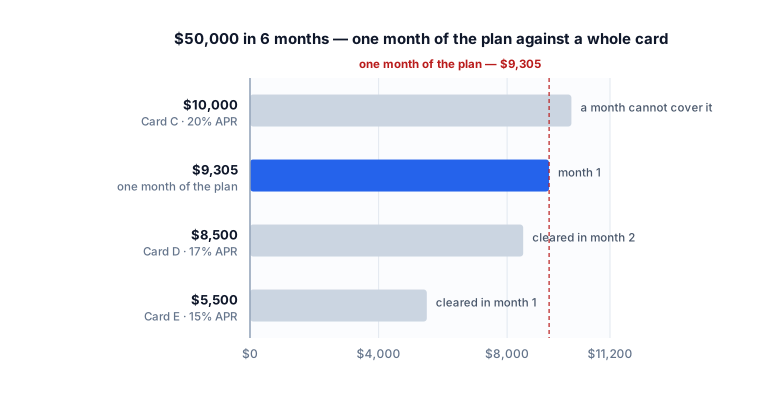
$9,305 a month is a strange number to look at until you set it beside the balances. It is $805 more than the whole of Card D ($8,500) and $3,805 more than the whole of Card E ($5,500) — a single month's payment could clear either of them outright. It is $695 short of Card C ($10,000) and $5,695 short of Card A ($15,000). The payment sits inside the card list, between the third and fourth balances.
That is what a six-month deadline does at this size. The plan is not five cards paid down together; it is cards bought out one at a time. Card E goes in month 1 and Card D in month 2, and each of those months is covered by one payment. By the time the schedule reaches Card A — $15,000 at 25%, the most expensive balance in the portfolio — three months are left and nothing else is in the way.
| Amount | What it is | One month beats it by |
|---|---|---|
| $9,305 the plan | One month of the six-month schedule | — |
| $8,500 Card D | The whole balance, at 17% APR | $805 |
| $5,500 Card E | The whole balance, at 15% APR | $3,805 |
The $9,305 is not a flat bill for six months, because only part of it is fixed. The $8,055 of new money never moves. The $1,250 of minimums bundled inside the payment does: it is the sum of the minimums still owed on cards that carry a balance, so it shrinks as cards leave the list — $1,250 in month 1, then $1,113, $900, $650, $650 and finally $375, with only Card A still open. The six payments therefore come out at $9,305, $9,168, $8,955, $8,705, $8,705 and $8,429.29, and they add to $53,267.29 — $2,562.71 below the $55,830 that six flat $9,305 payments would total.
The balance moves much faster than the payment. It is already down to $24,833.40 by month 3 — just under half of $50,000 — while the month-3 payment is still $8,955. So the second half of the plan is paid against a pile less than half the size of the first, and the payment barely notices.
What the plan costs, and what the method is worth
The six months cost $3,267.29 of interest, and the total that leaves your account is $53,267.29 — the $50,000 balance plus that interest. The interest is 6.53% of the balance you started with and 6.13% of everything you send.
Snowball is not the cheapest way to spend those six months. Avalanche, run at the same $9,305 a month, is charged $2,779.40 — $487.89 less, which is 14.93% of the snowball interest bill. Avalanche can also clear the balance at its own lower threshold of $9,186, and at that smaller payment the same six months cost $2,809.85; the $2,779.40 above is the equal-payment figure, so the two numbers differ by the payment they are measured at, not by the method.
What the method changes is the order the cards leave in. Snowball clears Card E in month 1, Card D in month 2, Card C in month 3, Card B in month 5 and Card A in month 6. Avalanche clears Card A in month 2, Card B in month 4, Card C in month 5, and finishes Card D and Card E together in month 6. Both are debt-free at month 6, and the $487.89 is real money — but it is not the lever here. The payment is, and the payment is set by the deadline.
The same six months, on minimums only
Sending $1,250 a month clears this portfolio in 87 months — more than seven years — and costs $39,456.55 in interest, a total bill of $89,456.55. The six-month plan's $3,267.29 is a saving of $36,189.26.
The same-term comparison is the sharper one, because both plans are spending the same six months. The minimums move $7,500 out of your account, of which $5,124.89 is interest and only $2,375.11 reaches principal, leaving $47,624.89 still owed. Six months of minimums therefore charge $1,857.60 more interest than the entire six-month plan — you can pay more interest in half a year than a working plan charges from start to finish, and the variable that decides which happens is the size of the payment.
Where the $8,055 comes from
This is the part that decides whether the plan happens, so it is worth stating plainly: you need $8,055 a month above the $1,250 you already pay — 6.4 times the minimums — and over the six months the new money alone is $48,330. At $25 an hour after tax that is roughly 74 extra hours a week, which is a second job rather than overtime.
Two things soften it. The floor narrows on its own, so the payment is under $9,000 from month 3 without you changing anything, and the last payment is $8,429.29. And the balance is halved by month 3, so the second half of the plan is carrying a much smaller pile than the first.
Reproduce these numbers
Every figure on this page comes from this site's public API. Post the five balances, their rates, their minimums and extra: 8055 to /api/payoff and you get the same months, the same $3,267.29 and the same per-card breakdown. Two things that trip people up: APR goes in as a percentage (25, not 0.25), and extra is the amount above your total minimums, not your total payment — $8,055 here, which is what turns the $1,250 in minimums into $9,305 a month. Or just open the calculator and type your balances in — same engine, no payload.
If your target is a different size or a different deadline, the same analysis is in the $60K in 6 months, $50K in 2 years, $40K in 6 months, $40K in 1 year, $30K in 6 months, $20K in 6 months, $15K in 6 months, $10K in 6 months, $5K in 6 months, $5K in 1 year, $10K, $15K, $20K, $25K, $30K and $100K case studies, plus a 36-second walkthrough of the $25K case on YouTube. Shorter answers to the most common payoff questions live in the payoff questions hub.
Frequently asked
How much do I have to pay a month to clear $50,000 in six months?
On the five-card example here, $9,305 a month clears the $50,000 in six months on the snowball method, which is $8,055 above the $1,250 in minimums. Avalanche needs less — $9,186 — because it goes at the 25% card first.
How much interest do I pay on $50,000 over six months?
The snowball plan is charged $3,267.29 and the total that leaves your account is $53,267.29 — the $50,000 balance plus that interest. The interest is 6.53% of the balance you started with and 6.13% of everything you send. Run at the same $9,305 a month, avalanche is charged $2,779.40, which is $487.89 less — 14.93% of the snowball interest bill.
Why is the six-month payment bigger than one of the cards?
Because a six-month deadline on $50,000 produces a payment that is not really a payment. The exact figure is $9,305 a month, and the five opening balances are $15,000, $11,000, $10,000, $8,500 and $5,500. The month-1 payment is larger than the whole of Card D by $805 and larger than the whole of Card E by $3,805, so the first two months of the schedule each retire a card outright. It is $695 short of Card C and $5,695 short of Card A.
Why is the payment $9,305 in month 1 and less later on?
Because only part of it is fixed. The $8,055 of new money never moves, but the $1,250 of minimums bundled inside the payment is the sum of the minimums still owed on cards that carry a balance, and it shrinks as cards leave the list — $1,250 in month 1, then $1,113, $900, $650, $650 and finally $375, with only Card A still open. The six actual payments run $9,305, $9,168, $8,955, $8,705, $8,705 and $8,429.29, which adds to $53,267.29 — $2,562.71 below the $55,830 that six flat $9,305 payments would total.
Does snowball versus avalanche matter on $50,000 over six months?
It is worth $487.89 over the six months, which is 14.93% of the snowball interest bill. Both figures are for the same $9,305 a month: snowball pays $3,267.29 and avalanche pays $2,779.40. Avalanche can also clear the balance at its own lower threshold of $9,186, and at that smaller payment the same six months cost $2,809.85 — a different payment, not a different answer. The payoff orders differ — snowball clears Card E, then Card D, then Card C, then Card B and finally Card A, while avalanche clears Card A first and finishes on Card D and Card E together in month 6 — but both methods reach zero in month 6.
What if I only pay the minimums on $50,000?
The $1,250 in minimums clears the balance in 87 months — more than seven years — and costs $39,456.55 in interest, a total bill of $89,456.55. That is a saving of $36,189.26 against the six-month plan's $3,267.29. Over the same six months the minimums move $7,500 out of your account, pay $5,124.89 of interest and retire only $2,375.11 of principal, leaving $47,624.89 still owed — $1,857.60 more interest than the whole six-month plan charges from start to finish.
What is the blended interest rate on this portfolio?
20.88% a year, weighted by balance: $15,000 at 25%, $11,000 at 22%, $10,000 at 20%, $8,500 at 17% and $5,500 at 15% work out to $10,440 of annual interest on $50,000. One twelfth of that is 1.74%, which is $870.00 on the opening balance — and $870.00 divided by $50,000 is exactly 20.88% divided by twelve. By month 6, under the plan, the monthly interest is down to $172.03.
How much new money do I have to find each month for a six-month $50,000 payoff?
$8,055 a month above the $1,250 you are already paying — 6.4 times the minimums — which over the six months is $48,330 of new money. At $25 an hour after tax that is roughly 74 extra hours a week. A budget rarely absorbs that, so at this size a six-month payoff is normally funded by a liquidity event: a property sold, an inheritance, a contract paid out, or retirement contributions paused for the year, and often two of those at once.