Numbers from this site's public API on a 5-card $70,000 portfolio at 15-25% APR. Open the calculator with your own balances and rates and the same numbers come out in real time.
The example portfolio
$70,000 is the size where the minimum payments alone cross $1,750 a month. This page uses five US credit cards — the same five-card shape and the same 25 / 22 / 20 / 17 / 15 APR ladder as the $60K and $50K two-year case studies, scaled to $70,000. Card A carries $20,000 at 25% APR with a $500 minimum; Card B $15,000 at 22% with a $375 minimum; Card C $14,000 at 20% with a $350 minimum; Card D $12,000 at 17% with a $300 minimum; Card E $9,000 at 15% with a $225 minimum. Every minimum is exactly 2.5% of its balance, and the five of them add up to $1,750 a month.
The rates run from 25% down to 15%, and the largest balance carries the highest rate. Weighted by balance, the portfolio's rate is 20.7% a year: $20,000 × 25%, $15,000 × 22%, $14,000 × 20%, $12,000 × 17% and $9,000 × 15% come to $14,490.00 of annual interest on a $70,000 balance. One twelfth of that is 1.725%, which on the opening balance is $1,207.50 for the first month — $416.67 on Card A, $275.00 on Card B, $233.33 on Card C, $170.00 on Card D and $112.50 on Card E.
To clear all five in twenty-four months, the snowball method needs $4,230 a month, which is $2,480 above the minimums. Avalanche needs less — $4,084 — because it goes straight at the 25% card. Every figure on this page is for the snowball plan unless it says otherwise.
Five races, one clock
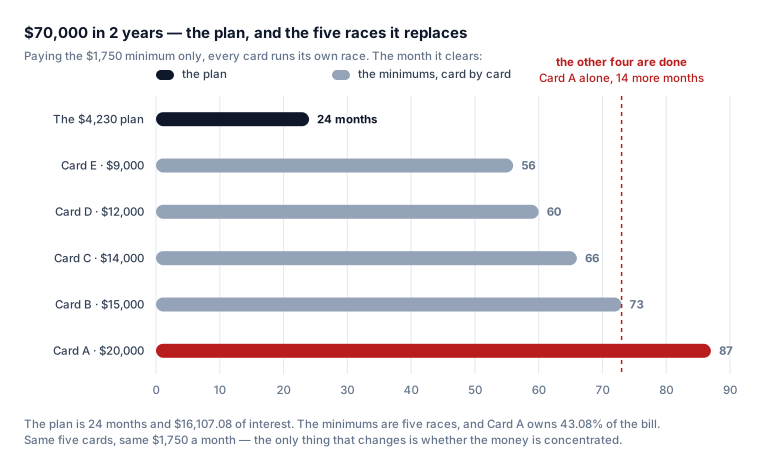
Twenty-four months is a long enough deadline that the interesting number is not the payment — it is what the alternative actually looks like. Paying the $1,750 minimum only, the five cards are not one portfolio being worked down; they are five separate races run side by side, because a minimum payment is 2.5% of its own balance and never touches another card. The money is never concentrated, so nothing is ever finished early for anyone else's benefit.
Run those five races out and they finish at five different months. Card E — the smallest balance and the lowest rate — clears in month 56. Card D in month 60. Card C in month 66. Card B in month 73. And Card A in month 87, because $20,000 at 25% with a $500 minimum is a 87-month job on its own. The four fastest are all done by month 73; the last 14 months belong to Card A alone, and that single card is charged $23,389.98 of the $54,288.30 bill — 43.08% of it.
That is the whole case for concentrating the money. The $4,230 plan finishes in 24 months instead of 87 — 3.625 times faster — and it does that by never letting one card hold the calendar. The card that takes the longest on its own is the card the snowball method feeds last but feeds hardest once it is the only one left: from month 19 onward Card A is the only card open, and the plan sends it $2,980 a month against its own $500 minimum.
| The card | Cleared in month | Interest at minimums | Share of the bill |
|---|---|---|---|
| Card E | 56 | $3,554.69 | 6.55% |
| Card D | 60 | $5,831.82 | 10.74% |
| Card C | 66 | $9,238.37 | 17.02% |
| Card B | 73 | $12,273.44 | 22.61% |
| Card A | 87 | $23,389.98 | 43.08% |
| All five cards | 87 | $54,288.30 | 100% |
Read the table top to bottom and the bill runs in the opposite direction to the calendar. Card E finishes first and owns 6.55% of the interest; Card A finishes last and owns 43.08%. Nothing about the order is decided by the balance you can see on a statement — it is decided by how long each card is allowed to sit there.
What the two years cost
The twenty-four months cost $16,107.08 of interest, and the total that leaves your account is $86,107.08 — the $70,000 balance plus that interest. The interest is 23.01% of the balance you started with and 18.71% of everything you send. That is what paying this fast buys: the whole two years of interest is 9.204 of the $1,750 minimum payments, and the monthly charge falls from $1,207.50 in month 1 to $60.55 in month 24 — 19.94 times less.
Snowball is not the cheapest way to spend those twenty-four months. Avalanche, run at the same $4,230 a month, is charged $12,914.46 — $3,192.62 less, which is 19.82% of the snowball interest bill — and it finishes a month early, in 23 months. Avalanche can also clear the balance at its own lower threshold of $4,084, and at that smaller payment it costs $13,543.92; the $12,914.46 above is the equal-payment figure, so the two numbers differ by the payment they are measured at, not by the method.
The payments step down five times as cards close: $4,230 in months 1 to 4, $4,005 in months 5 to 8, $3,705 in months 9 to 13, $3,355 in months 14 to 18, $2,980 in months 19 to 23, and $2,967.08 in month 24. Each drop is exactly the minimum of the card that just cleared — $225 for Card E, $300 for Card D, $350 for Card C, $375 for Card B — and the fifth drop, Card A's $500, never arrives: the plan ends at $2,967.08 instead of $2,480. The balance path is $66,977.50, $63,915.24, $60,812.68, $57,669.29, $54,706.90, $51,701.18, $48,651.50, $45,557.19, $42,715.40, $39,825.64, $36,887.11, $33,898.97, $30,860.40, $28,118.10, $25,325.25, $22,480.92, $19,584.16, $16,634.01, $14,000.55, $11,312.23, $8,567.90, $5,766.40, $2,906.53 and zero.
The deadline itself is exact. $4,230 a month lands the payoff in twenty-four months; $4,229 adds a twenty-fifth. Avalanche's own deadline sits lower: $4,084 finishes in twenty-four months, and $4,083 pushes it to twenty-five. The first twelve months send $47,760.00 and the last twelve $38,347.08 — 19.71% less — but they retire almost the same balance: $36,101.03 against $33,898.97, a $2,202.06 spread, or 6.10% of the bigger half. The only thing that moves in the payment is the minimums you have stopped owing. Twenty-four flat payments of $4,230 would come to $101,520; the plan sends $86,107.08, so $15,412.92 of those flat payments never happens.
Where the $2,480 comes from
This is the part that decides whether the plan happens, so it is worth stating plainly: you need $2,480 a month above the $1,750 you already pay — 1.417 times the minimums — and over the twenty-four months the new money alone is $59,520, which is 85.03% of the balance. The plan pays 2.417 times the minimums and finishes the job in 24 months instead of 87.
Two comparisons make the size of the ask concrete. The whole two-year plan, at $86,107.08, is 69.28% of the $124,288.30 the minimums-only path would cost over 87 months: about two-thirds of the money, in a quarter of the time. And what the minimums do in those same twenty-four months is worth reading against the plan. They move $42,000 out of your account, of which $26,237.99 is interest and only $15,762.01 reaches principal — 37.53% of what you sent — and they leave $54,237.99 still owed, which is 77.48% of the original balance. The plan, over the same twenty-four months, sends $86,107.08 and ends at zero. Month 1 of the minimums is charged the same $1,207.50 the plan is, but of that $1,750 only $542.50 reaches principal — 31.00%, against 71.45% for the plan's first payment.
Stretching the same $70,000 from one year to two is a separate trade, and it is worth naming. The twelve-month plan on this portfolio is $7,164 a month and $8,442.15 of interest; the twenty-four-month plan is $4,230 a month and $16,107.08. So the extra year cuts the payment by $2,934 a month and adds $7,664.93 of interest — 1.91 times the twelve-month bill. You are buying cash flow, and you are paying for it in interest.
Reproduce these numbers
Every figure on this page comes from this site's public API. Post the five balances, their rates, their minimums and extra: 2480 to /api/payoff and you get the same months, the same $16,107.08 and the same per-card breakdown — including the clearedMonth on each card that the races table above is built from, once with extra: 2480 and once with extra: 0. Two things that trip people up: APR goes in as a percentage (25, not 0.25), and extra is the amount above your total minimums, not your total payment — $2,480 here, which is what turns the $1,750 in minimums into $4,230 a month. Or just open the calculator and type your balances in — same engine, no payload.
If your target is a different size or a different deadline, the same analysis is in the $70K in 12 months, $70K in 6 months, $60K in 2 years, $60K in 12 months, $60K in 6 months, $50K in 2 years, $50K in 12 months, $50K in 6 months, $40K in 1 year, $40K in 6 months, $30K in 6 months, $20K in 6 months, $15K in 6 months, $10K in 6 months, $5K in 6 months, $5K in 1 year, $10K, $15K, $20K, $25K, $30K and $100K case studies, plus a 36-second walkthrough of the $25K case on YouTube. Shorter answers to the most common payoff questions live in the payoff questions hub.
Frequently asked
How much do I have to pay a month to clear $70,000 in two years?
On the five-card example here, $4,230 a month clears the $70,000 in twenty-four months on the snowball method, which is $2,480 above the $1,750 in minimums. Avalanche needs less — $4,084 — because it goes at the 25% card first.
How much interest do I pay on $70,000 over two years?
The snowball plan is charged $16,107.08 and the total that leaves your account is $86,107.08 — the $70,000 balance plus that interest. The interest is 23.01% of the balance you started with and 18.71% of everything you send, and it is 9.204 of the $1,750 minimum payments. Run at the same $4,230 a month, avalanche is charged $12,914.46, which is $3,192.62 less — 19.82% of the snowball interest bill — and it finishes a month early, in 23 months.
Why does paying only the minimums take 87 months?
Because the minimums never concentrate. Each card pays only its own 2.5% of its own balance, so the five cards are five separate races run side by side, not one portfolio: Card E clears in month 56, Card D in month 60, Card C in month 66, Card B in month 73 and Card A in month 87. The four fastest are all finished by month 73; the last 14 months are Card A alone, and Card A by itself is charged $23,389.98 of the $54,288.30 bill — 43.08% of it.
Which card sets the 87-month clock?
Card A — the $20,000 card at 25% with the $500 minimum. On its own, $20,000 at 25% with $500 a month takes 87 months, and that single race is the whole portfolio's clock: the other four cards are done at months 56, 60, 66 and 73. If you never concentrate the money, one card holds the calendar. That is the entire case for the snowball method on this portfolio — the $4,230 plan finishes in 24 months, 3.625 times faster.
Does it matter which card I pay off first on a two-year plan?
It is worth $3,192.62 at the same $4,230 a month, which is 19.82% of the snowball interest bill — and avalanche also finishes a month early, in 23 months. Snowball clears Card E in month 4, Card D in month 8, Card C in month 13, Card B in month 18 and Card A in month 24; avalanche clears Card A in month 8, Card B in month 13, Card C in month 17, Card D in month 21 and Card E in month 23. Card A is 28.57% of the balance but 52.37% of the snowball interest bill — $8,435.49 of the $16,107.08.
What if I only pay the minimums on $70,000?
The $1,750 in minimums clears the balance in 87 months — more than seven years — and costs $54,288.30 in interest, a total bill of $124,288.30. The twenty-four-month plan is charged $16,107.08, a saving of $38,181.22. The plan also finishes 3.625 times faster: 24 months against 87. Month 1 of the minimums is charged the same $1,207.50 the plan is, but only $542.50 of that $1,750 reaches principal, against $3,022.50 of the plan's first payment.
What do two years of the minimums actually retire?
Twenty-four months of minimums moves $42,000 out of your account. Of that, $26,237.99 is interest and only $15,762.01 reaches principal — 37.53% of what you sent — so after two years you still owe $54,237.99, which is 77.48% of the balance you started with. The plan, over the same twenty-four months, sends $86,107.08 and ends at zero.
What is the blended interest rate on this portfolio?
20.7% a year, weighted by balance: $20,000 at 25%, $15,000 at 22%, $14,000 at 20%, $12,000 at 17% and $9,000 at 15% work out to $14,490.00 of annual interest on $70,000. One twelfth of that is 1.725%, which is $1,207.50 on the opening balance — $416.67 on Card A, $275.00 on Card B, $233.33 on Card C, $170.00 on Card D and $112.50 on Card E. By month 24, under the plan, the monthly interest is down to $60.55 — 19.94 times less than month 1.