Numbers from this site's public API on a 4-card $20,000 portfolio at 15-24% APR. Open the calculator with your own balances and rates and the same numbers come out in real time.
The example portfolio
"Can I pay off $20,000 in a year" is not answerable in the abstract — it depends on how the balance is split and what each piece costs you. The example below uses four US credit cards with balances deliberately bunched together, including two that tie at $4,500, because that is the shape most real $20,000 stacks take: not one giant card, but four mid-sized ones.
| Card | Balance | Min payment | APR |
|---|---|---|---|
| Card A | $6,000 | $150 | 24% |
| Card B | $5,000 | $125 | 19% |
| Card C | $4,500 | $110 | 22% |
| Card D | $4,500 | $115 | 15% |
| Total | $20,000 | $500 | — |
What minimums-only actually costs on $20,000
This is the number that rarely gets printed next to the one-year headline. Sending $500 a month — the minimums, nothing more — clears this portfolio in 82 months on snowball and 80 on avalanche. Interest comes to $14,727.64. That means you repay the $20,000 and then pay another 74% of it again in interest, and you finish in your seventh year.
So the honest framing of a one-year $20,000 payoff is not "I need $2,100 a month." It is "the gap between doing nothing extra and doing the one-year plan is $12,568 in interest and 70 months of your life." The monthly payment is just the lever.
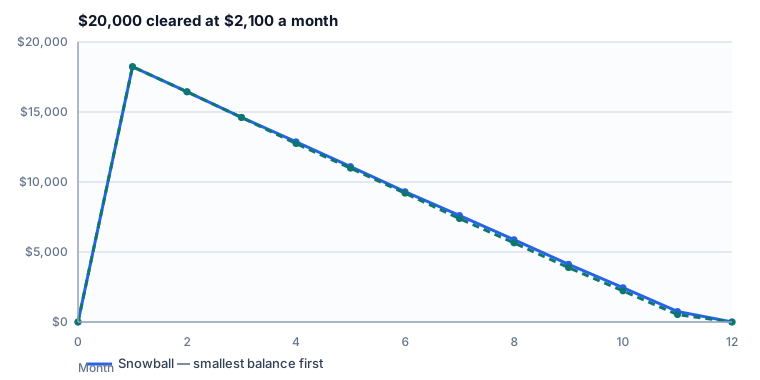
Both methods finish in 12 months at $2,100/month
At $2,100 a month the two methods land on the same month, and the payoff orders are genuinely different rather than cosmetic. Snowball clears the two $4,500 cards first. Avalanche goes straight at the 24% card. Both finish at month 12; avalanche costs $261.13 less.
| Method | Payoff order | Months | Total interest |
|---|---|---|---|
| Snowball | C → D → B → A | 12 | $2,160 |
| Avalanche | A → C → B → D | 12 | $1,899 |
Here is the part most method arguments skip. On this portfolio, choosing avalanche over snowball is worth $261. Going from minimums to $2,100 a month is worth $12,568. The payment size is 48 times more powerful than the method. If you are spending your energy arguing about which order to pay cards in while your monthly payment stays flat, you are optimizing the wrong variable.
Where each card dies, month by month
The psychological case for snowball is the early win, and on this portfolio it is real: the first card is gone at month 3, three months before avalanche kills its first one. Avalanche's first card takes four months because it is the $6,000 balance. What avalanche gives you instead is a cheaper back half.
| Month | Snowball | Avalanche |
|---|---|---|
| 3 | Card C cleared ($4,500, 22%) | — |
| 4 | — | Card A cleared ($6,000, 24%) |
| 6 | Card D cleared ($4,500, 15%) | — |
| 7 | — | Card C cleared ($4,500, 22%) |
| 9 | Card B cleared ($5,000, 19%) | Card B cleared ($5,000, 19%) |
| 12 | Card A cleared ($6,000, 24%) | Card D cleared ($4,500, 15%) |
What if you can't free up $1,600 a month?
Then the plan becomes a 15-month, an 18-month or a 27-month plan, and all three are still dramatically better than 82 months. The curve is steepest at the bottom: the first $400 above minimums cuts 28 months off the timeline. The last $100 before the one-year mark cuts one month.
| Total monthly | Months (snowball) | Months (avalanche) | Interest (snowball) | Interest (avalanche) |
|---|---|---|---|---|
| $500 (minimums) | 82 | 80 | $14,728 | $14,702 |
| $700 | 54 | 48 | $8,910 | $7,715 |
| $900 | 36 | 34 | $6,220 | $5,331 |
| $1,100 | 27 | 26 | $4,706 | $4,072 |
| $1,300 | 22 | 21 | $3,792 | $3,304 |
| $1,500 | 18 | 18 | $3,158 | $2,770 |
| $1,700 | 15 | 15 | $2,745 | $2,397 |
| $1,800 | 14 | 14 | $2,561 | $2,244 |
| $2,000 | 13 | 13 | $2,287 | $2,005 |
| $2,100 | 12 | 12 | $2,160 | $1,899 |
| $2,400 | 10 | 10 | $1,872 | $1,643 |
Note what happens at $700 a month: the methods stop agreeing. Snowball takes 54 months, avalanche takes 48 — a six-month gap, worth $1,195. The lower your payment, the more the method matters, because you are paying interest for long enough that the rate ordering compounds. At a high payment the two methods converge; at a low payment they diverge.
How to actually free up $1,600 extra each month
A one-year payoff on $20,000 is not a budgeting puzzle, it is an income and asset puzzle. $1,600 a month is $19,200 over the year — very few budgets have that much slack to cut. In practice people get there from a mix, and usually from the top of this list rather than the bottom:
- Sell something. A second car, a motorcycle, an unused instrument, a camera kit. One asset sale of $5,000 to $8,000 is a quarter to a half of what the whole year needs, and it arrives as a lump you can throw at the first card in month one.
- Overtime or a second income for a fixed term. Twelve months of 8 extra hours a week at $20/hour is about $8,300 after tax. Frame it as a one-year project with an end date, not a permanent second job.
- Pause retirement contributions above the match. Redirecting $300 a month for one year costs you one year of contributions and saves roughly $12,500 in interest. The match itself is free money — keep contributing at least up to it.
- Refinance the biggest line item, not the cards. If you have an auto loan, the payment is usually larger than any card minimum. Cutting a $450 car payment to $300 frees $150 a month for a year with no change to your cards.
- A 0% balance transfer, only if the math clears. A 3% to 5% fee on $20,000 is $600 to $1,000. Compare it against the $261 the method choice is worth and against however many months of 22% interest it removes. Model it in the calculator before you apply — do not assume the transfer wins.
Two cautions. First, none of this works if new charges keep landing on the cards; a one-year plan assumes the balance only moves in one direction. Second, if your APRs are higher than the 15-24% range used here, every month figure above gets longer and every interest figure gets bigger — rerun it with your real numbers instead of borrowing these.
Run your own numbers
Everything on this page came out of this site's API, so you can reproduce it or change it. The endpoint takes your cards and the extra you can pay:
POST https://debtsnowballtool.com/api/payoff
{
  "debts": [
    {"name":"Card A","balance":6000,"apr":24,"minPayment":150},
    {"name":"Card B","balance":5000,"apr":19,"minPayment":125},
    {"name":"Card C","balance":4500,"apr":22,"minPayment":110},
    {"name":"Card D","balance":4500,"apr":15,"minPayment":115}
  ],
  "extra": 1600
}
Two things that trip people up: APR goes in as a percentage (24, not 0.24), and extra is the amount above your total minimums, not your total payment. Or just open the calculator and type your balances in — same engine, no payload.
If your balance is closer to $30,000 than $20,000, the same analysis at that size is in the $30K in 1 year case study; if it is closer to $10,000, there is a $10K version built on three cards at 18-26% APR.
Frequently asked questions
Can you pay off $20,000 in debt in 1 year?
Yes. With four cards totalling $20,000 at 15% to 24% APR, paying $2,100 a month clears the balance in 12 months on both the snowball and the avalanche method. Interest comes to about $1,899 on avalanche and $2,160 on snowball.
How much do I have to pay each month to clear $20,000 in a year?
$2,100 a month total on the example portfolio. That is $1,600 on top of the $500 in minimum payments across the four cards. At $2,000 a month you land on 13 months, so $2,100 is the point where the plan fits inside a year.
What happens if I only pay the minimums on $20,000?
On the four-card example it takes 82 months, which is nearly seven years, and costs $14,727.64 in interest on the snowball method. That is 74% of the original balance paid again in interest alone.
Is it better to use the snowball or avalanche method on $20,000?
Avalanche is cheaper by $261.13 over the 12 months on this portfolio. That is real money but it is small compared with the payment size: going from minimums to $2,100 a month saves $12,568, which is 48 times more than the method choice is worth.
Should I use a 0% balance transfer to pay off $20,000 faster?
It can work if you can move most of the balance and clear it inside the promotional window, but the transfer fee usually runs 3% to 5%, which is $600 to $1,000 on $20,000. Compare that against the $261 the method choice is worth. Run both scenarios in the calculator before you apply.
Do I need to stop using the cards while paying them off?
Yes. Every number on this page assumes zero new charges. If you keep spending on the cards, the balances stop shrinking no matter how much extra you send. A common trick is to remove the cards from your mobile wallet and freeze the physical cards so using one takes effort.