Numbers from this site's public API on a 3-card $10,000 portfolio at 18-26% APR. Open the calculator with your own balances and rates and the same numbers come out in real time.
The example portfolio
"Can I pay off $10,000 in six months" is not answerable in the abstract — it depends on how the balance is split and what each piece costs you. This page uses three US credit cards totalling $10,000. Card A carries $4,000 at 26% APR with a $120 minimum; Card B carries $3,500 at 21% with a $100 minimum; Card C carries $2,500 at 18% with an $80 minimum. The three minimums add up to $300 a month. The rates are stacked so the smallest balance is also the cheapest card — the shape that makes the snowball-versus-avalanche question actually matter, and the shape most real $10,000 stacks take: one card near its limit, two in the middle.
To clear all three in six months, the snowball method needs $1,868 a month, which is $1,568 above the minimums. Avalanche needs slightly less — $1,845 — because it goes straight at the 26% card. Both land in month 6. Every figure on this page is for the snowball plan unless it says otherwise, and every one of them comes out of the same engine that runs the calculator.
Where the money goes, month by month
Six months, $1,868 in month 1, on the snowball method. The payment is not the same every month — the reason is below the table — so this is what actually leaves the account each month, and where each payment lands:
| Month | Payment | Principal | Interest | Interest paid | Balance |
|---|---|---|---|---|---|
| 1 | $1,868.00 | $1,682.58 | $185.42 | $185.42 27.00% | $8,317.42 |
| 2 | $1,868.00 | $1,708.14 | $159.86 | $345.28 50.27% | $6,609.28 |
| 3 | $1,788.00 | $1,655.96 | $132.04 | $477.32 69.50% | $4,953.32 |
| 4 | $1,788.00 | $1,685.07 | $102.93 | $580.25 84.48% | $3,268.25 |
| 5 | $1,688.00 | $1,617.19 | $70.81 | $651.06 94.79% | $1,651.06 |
| 6 | $1,686.83 | $1,651.06 | $35.77 | $686.83 100.00% | $0.00 |
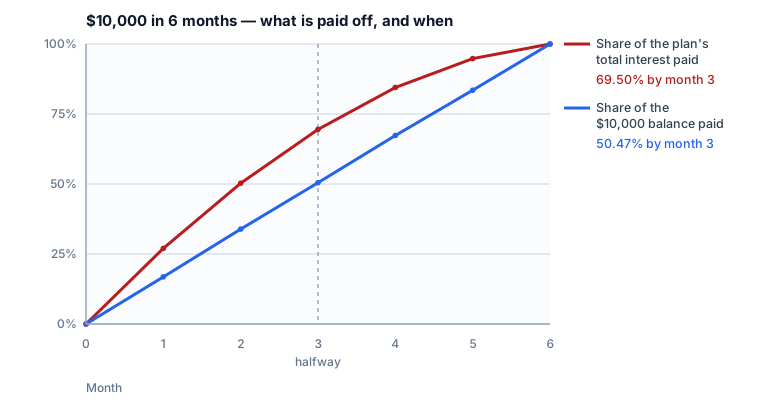
Read the two shares together, because they are measured against two different things. The 69.50% sitting beside the month-3 figure is $477.32 divided by the plan's total interest of $686.83 — how much of the interest bill is already behind you by the halfway mark. The principal retired by the same point is $5,046.68, which is 50.47% of the original $10,000 — how much of the debt itself is actually gone. Neither share is measured against the monthly payment, and neither is measured against the other; one is progress through the interest, the other is progress through the debt, and at the halfway point they are nineteen points apart.
That gap is the whole point. Interest is charged on the balance you are still carrying, and the balance is largest in month 1, so the early months are the expensive ones. Month 1 costs $185.42 in interest and month 6 costs $35.77 — a factor of 5.18. The first three months together carry $477.32 (69.50%) of the plan's interest; the last three carry $209.51 (30.50%). So when you are halfway through the calendar you are not halfway through the cost, and a plan that is abandoned at month 3 has already spent most of what it was going to spend.
Why the payment is $1,868 in month 1 and less later
Take $1,868 and multiply by six and you get $11,208. The six months do not cost that — they cost $10,686.83 — and the reason is worth understanding because it repeats on every payoff plan. A card's minimum payment is part of your monthly total only while that card still has a balance. The month a card is cleared, its minimum drops out of the budget, and the required payment falls by that amount, so the money leaving your account steps down through the plan instead of staying flat.
On this portfolio it steps down twice. Card C, the $2,500 balance at 18%, is cleared in month 2, which takes its $80 minimum off the monthly total from month 3. Card B, $3,500 at 21%, is cleared in month 4, taking another $100 off from month 5. So the plan is really $1,868 for two months, $1,788 for two, $1,688 for one, and then $1,686.83 in month 6 to finish the last card. Add those up and you get $10,686.83 — exactly $521.17 less than the flat multiplication, and the difference is the two minimums you stopped paying once their cards were gone.
It also means the plan gets easier as it goes, which is the opposite of how most budgets feel. Month 1 demands $1,868; month 5 demands $1,688. The finish line does not move — month 6 either way — but the last third of the plan asks for less than the first third, because the work you already did shrank the minimums you owe.
What the halfway point tells you
The six-month plan is fast, and speed is what makes it cheap: $686.83 of interest on $10,000 is 6.87% of the balance, and it is 11.42% of the $6,015.74 you would pay by sending the $300 minimums for 59 months — a saving of $5,328.91. What the halfway measurement adds is a warning about when that cost is paid. If you have to stop at month 3, you have already paid 69.50% of the interest and retired barely half the debt; the cheap part of the plan is the second half, and you only reach it by finishing.
The method question is worth much less here than the discipline question. At $1,868 a month, avalanche finishes the same six months with $598.15 in interest, a gap of just $88.68. The reason is simple: over six months the balance is gone before compounding has time to reward the better order. The order still matters — snowball kills the $2,500 card in month 2 and gets its psychological win, avalanche kills the 26% card in month 3 and saves the $88.68 — but the size of the prize is small compared with simply making the payment every month.
Where the extra $1,568 a month comes from
The plan needs $1,568 above the $300 in minimums, which is $9,408 over six months — 94.08% of the balance. At $25 an hour after tax that is about 14.5 extra hours a week; at $30 an hour it is about 12.1.
- Make it a transfer, not a decision. Six months is short enough to automate: set the payment for payday and let it run. Re-deciding it every month is how these plans die.
- Kill the biggest non-card payment. A $400 car payment refinanced to $250 frees $150 a month — nearly a tenth of the requirement, from one phone call.
- Pause retirement contributions above the match. Redirecting $300 a month for six months frees $1,800, more than a third of the $5,328.91 the plan saves in interest. Keep contributing up to the employer match; that part is free money and stopping it is a real loss.
- Ask the 26% card for a lower rate. Card A carries the highest rate and the largest balance here, so a few points off it is worth more than the same cut anywhere else — and it takes one call.
- Watch the 0% balance-transfer arithmetic. A 3% to 5% fee on $10,000 is $300 to $500 against $686.83 of interest on this plan, so a single offer can cover most of the cost — but only if the whole $10,000 moves and the balance is cleared before the promotional window closes. Anything still standing when it closes starts accruing at the standard rate. Model it in the calculator before you apply.
Run your own numbers
Everything on this page came out of this site's API, so you can reproduce it or change it. The endpoint takes your cards and the extra you can pay:
POST https://debtsnowballtool.com/api/payoff
{
  "debts": [
    {"name":"Card A","balance":4000,"apr":26,"minPayment":120},
    {"name":"Card B","balance":3500,"apr":21,"minPayment":100},
    {"name":"Card C","balance":2500,"apr":18,"minPayment":80}
  ],
  "extra": 1568
}
Two things that trip people up: APR goes in as a percentage (26, not 0.26), and extra is the amount above your total minimums, not your total payment — $1,568 here, which is what turns the $300 in minimums into $1,868 a month. Or just open the calculator and type your balances in — same engine, no payload.
If your target is a different size or a different deadline, the same analysis is in the $5K, $10K, $15K, $20K, $25K, $30K, $40K, $50K and $100K case studies, plus a 36-second walkthrough of the $25K case on YouTube. Shorter answers to the most common payoff questions live in the payoff questions hub.
Frequently asked questions
How much do I have to pay a month to clear $10,000 in 6 months?
On the three-card example here, $1,868 a month clears the $10,000 in six months on the snowball method, which is $1,568 above the $300 in minimums. Avalanche needs slightly less, $1,845, because it goes at the highest-rate card first.
How much of a six-month payoff plan goes to interest?
$686.83 on the snowball method and $598.15 on the avalanche, a gap of $88.68. The total that leaves your account over the six months is $10,686.83 on snowball — the $10,000 balance plus $686.83 of interest.
Why is the payment $1,868 in month 1 but less later on?
Because each card's minimum drops out of your budget the month that card is cleared. The $2,500 card goes in month 2, removing $80 a month, and the $3,500 card goes in month 4, removing $100. So the plan is really $1,868 for two months, $1,788 for two, $1,688 for one and $1,686.83 to finish — $10,686.83 in total, which is $521.17 less than multiplying the starting payment by six.
At the halfway point of a six-month plan, how much of the interest is already paid?
$477.32 of the plan's $686.83 total interest, which is 69.50%. The principal retired by the same point is $5,046.68, or 50.47% of the $10,000 balance, and $4,953.32 is still owed. The two shares use two different denominators — 69.50% against the plan's total interest and 50.47% against the original balance — and neither is against the monthly payment.
Is snowball or avalanche better on a six-month plan?
At $1,868 a month the difference is $88.68 over the whole plan — avalanche pays $598.15 in interest and snowball pays $686.83. At this speed the order barely matters: the balance is gone before compounding has time to punish the wrong sequence. Snowball's win is psychological (the first card dies in month 2); avalanche's win is the $88.68.
What if I only pay the minimums on $10,000?
The $300 in minimums clears the balance in 59 months — nearly five years — and costs $6,015.74 in interest, a total bill of $16,015.74. The six-month plan's $686.83 is 11.42% of that, a saving of $5,328.91.
Do I need to stop using the cards while paying off $10,000 in six months?
Yes. Every number here assumes zero new charges. On a six-month plan the margin is thin: the whole plan spends only $686.83 on interest, so a single new balance carrying 20%-plus interest can undo months of progress. A common approach is to remove the cards from your mobile wallet and freeze the physical ones so using one takes deliberate effort.
My APRs are higher than 18-26% — does this still apply?
The structure holds but the numbers move. Higher rates make the interest front-loading worse — more of the early months goes to interest and less to principal — and they push the required payment up. Rerun it with your real balances and rates instead of borrowing these.