Numbers from this site's public API on a 5-card $30,000 portfolio at 14-22% APR. Open the calculator with your own balances and rates and the same numbers come out in real time.
The example portfolio
To answer "can you pay off $30,000 in a year" with a number instead of a guess, you need real balances and real rates. The example below uses five US credit cards at the APRs you'd find on a typical rewards card stack today — not the worst case, not the best.
| Card | Balance | Min payment | APR |
|---|---|---|---|
| Card A | $8,000 | $200 | 22% |
| Card B | $7,000 | $175 | 20% |
| Card C | $6,000 | $150 | 18% |
| Card D | $5,000 | $125 | 16% |
| Card E | $4,000 | $100 | 14% |
| Total | $30,000 | $750 | — |
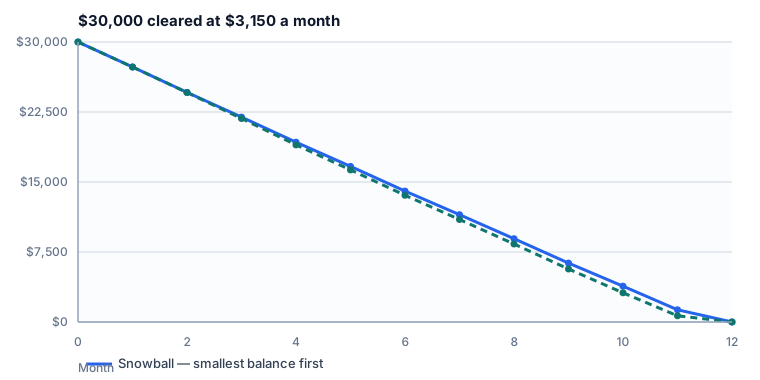
Both methods agree on 12 months at $3,150/month
The reason snowball and avalanche finish in the same month here is that the smallest balance is also the highest APR card. When your balances and APRs line up that way, the two methods are mathematically identical — every extra dollar goes to the same card first. The only thing that changes is the label on the order. On a different portfolio where your smallest balance is not your highest APR card, avalanche finishes 1 to 3 months sooner and saves anywhere from $500 to $1,500 in interest, depending on how steep the rate gap is.
| Method | Payoff order | Months | Total interest |
|---|---|---|---|
| Snowball | E → D → C → B → A | 12 | $3,101 |
| Avalanche | A → B → C → D → E | 12 | $2,622 |
What if you can't free up $3,150 a month?
The number isn't linear. The extra payment that turns a 24-month plan into a 12-month plan is roughly $450/month on this portfolio. The extra payment that turns a 36-month plan into a 24-month plan is only $300. Pulling an extra $150/month out of the budget gets you about 6 months shaved off, not 3.
| Extra above $750 min | Total monthly | Months (snowball) | Months (avalanche) | Total interest (snowball) |
|---|---|---|---|---|
| $300 | $1,050 | 53 | 47 | $12,636 |
| $600 | $1,350 | 36 | 34 | $8,894 |
| $900 | $1,650 | 27 | 26 | $6,708 |
| $1,200 | $1,950 | 22 | 21 | $5,412 |
| $1,500 | $2,250 | 18 | 17 | $4,534 |
| $1,650 | $2,400 | 17 | 16 | $4,195 |
| $2,100 | $2,850 | 13 | 13 | $3,452 |
| $2,400 | $3,150 | 12 | 12 | $3,101 |
The asymmetry above $3,150 — at $2,850/month both methods need 13 months — is because at that point the smallest card (Card E) clears inside month 1 and the freed-up $100 minimum rolls into Card D, which also clears by month 2. Once you have rollovers feeding the next debt at full speed, throwing more cash at the top doesn't shorten the schedule linearly.
How to actually free up $2,400 extra each month
"$2,400 extra above minimums" is the part of the page most other calculators skip. Here are five places the money usually comes from when people actually do this:
- Cancel a subscription you don't use. The average US household spends $219/month on streaming and recurring apps they forgot they had. Cancel four of them and you've cleared $40-80.
- Drop one car or one delivery habit. A second car costs $600-900/month fully loaded. A daily $15 lunch delivery is $300/month.
- Pick up a 13-week side project. $2,400/month × 1 month = one big freelancing gig. 13 weeks = one quarter of focused extra income.
- Move the money before you see it. On payday, auto-transfer the $2,400 to a separate account the day before direct deposit lands. If you never see it in your checking account, you don't miss it.
- Sell one thing. $2,400 is roughly the take-home from selling one car, one piece of unused gear, or one season of an item you bought and stopped using.
What changes the numbers
- If your APRs are higher than the example, you need slightly more than $3,150 to clear in 12 months, because interest charges faster. At 26% across the board the 12-month break-even is about $3,250.
- If your APRs are lower, interest is cheaper but the snowball vs avalanche gap shrinks. At 8% across the board both methods finish within a month of each other regardless of order.
- If you have a fixed monthly budget instead of "minimums + extra", use the budget mode at the top of the calculator. You tell it "I can pay $3,150/month and the minimums come out of that first."
- If you keep charging new purchases, the model assumes you stop. If you keep using the cards, the balances stop shrinking and the year becomes a year-and-a-half.
Common questions
Can you actually pay off $30,000 in a year?
Yes, if you can free up $3,150/month against the balances on the example portfolio. Below $3,150/month the timeline stretches to 18, 24, 36 months or longer. The math doesn't lie — at 14-22% APR, $30K is gone in 12 months at $3,150/mo by either method.
How much do I need to pay each month?
$3,150/month on this mix, which is $2,400 on top of the $750 in minimums. On your own mix, run the calculator — the required payment depends on your APRs and minimums, not just your balance.
Is snowball or avalanche better for $30,000?
On this specific example, snowball and avalanche finish in the same month and avalanche costs $479 less. On a different mix where smallest balance ≠ highest APR card, avalanche saves more and finishes sooner. The default answer is avalanche unless you think clearing a small balance first keeps you motivated — motivation is real.
Will my credit score drop?
Short term, yes — closing cards lowers your total credit and the score models penalize it. Utilization stays low (which helps) but the closed-card effect wins for a few months. The score usually recovers within 6 to 12 months and ends up higher because you have no missed payments and zero utilization on cards you closed.
Do I have to stop using the cards?
Yes. Any new charge offsets the extra payment you just made. The 12-month math assumes zero new charges. Freeze the cards in a block of ice in the freezer, cut them up, or hand them to someone you trust — whatever it takes. If you can't go a year without a card, leave one open for emergencies and freeze the rest.
What if I miss a month?
One missed month adds roughly 1-2 months to the schedule. The interest keeps accruing while you only pay minimums. Get back on track the next month. The plan doesn't break from one bad month; it breaks from giving up after three.
Run it on your own numbers
Type your five balances and APRs into the calculator and the answer is yours in real time. The numbers in this article come from the same tool — there is no "trust me, it works," there is the API endpoint and the JSON it returns. For the full month-by-month schedule, hit "Download spreadsheet" at the bottom of the calculator and open the CSV in Excel, Google Sheets, or Numbers.