Numbers from this site's public API on a 5-card $50,000 portfolio at 15-25% APR. Open the calculator with your own balances and rates and the same numbers come out in real time.
What the second year buys, and what it costs
The one-year plan and the two-year plan are not two versions of the same thing. They are two different prices for the same $50,000, and the gap between them is the only number on this page that changes a decision rather than describing one. Both rows are total interest paid over the life of the plan:
| Plan | Per month | Months | Snowball | Avalanche |
|---|---|---|---|---|
| One year | $5,123 | 12 · both | $6,072.03 | $5,041.39 |
| Two years | $3,013 | 24 · 23 | $11,620.35 | $9,371.18 |
Read the months column with the method in mind: the one-year plan finishes in month 12 either way, and the two-year plan reads 24 months on snowball and 23 on avalanche.
Read the last column against the payment column and the trade is exact. Taking the second year takes $2,110 out of the monthly payment — that figure is the relief, and it is measured per month, every month for 24 months — and it adds $5,548.32 to what the debt costs — that figure is the cost, and it is measured as extra interest totalled across all 24 payments, not per month. Put both on the same footing and the second year runs at $2.63 of extra interest for every $1 it takes off your monthly bill.
| What the second year does | Amount | How it is measured |
|---|---|---|
| Relief | $2,110 | per month, every month, for 24 months |
| Cost | $5,548.32 | extra interest, totalled across all 24 payments |
| Exchange rate | $2.63 | extra interest per $1 of monthly relief |
That rate is the thing to argue with, not the headline. The division behind it is $5,548.32 ÷ $2,110 = 2.6295, rounded here to $2.63. And $2.63 is not self-evidently good or bad: it depends on what $2,110 a month is worth to you right now, and on whether the $5,123 version is a plan you would actually hold for twelve months or a number you would abandon in month four. What the rate does settle is that the second year is not a discount and not a penalty — it is a price, and it is the same price whether or not anyone has shown it to you.
One asymmetry is worth naming. The two-year plan asks for less extra money each month — $1,763 above minimums against $3,873 on the one-year plan — but it keeps the minimums running for a second year. That is where the $5,548.32 comes from.
The example portfolio
$50,000 across five US credit cards, with the largest balance carrying the highest rate and the smallest carrying the lowest. The $1,250 in minimum payments is 41.5% of the $3,013 the two-year plan needs — so on this portfolio the minimums are not a rounding error you pay on the way to the real payment, they are two fifths of the whole plan.
| Card | Balance | Min payment | APR |
|---|---|---|---|
| Card A | $15,000 | $375 | 25% |
| Card B | $11,000 | $275 | 22% |
| Card C | $10,000 | $250 | 20% |
| Card D | $8,500 | $213 | 17% |
| Card E | $5,500 | $137 | 15% |
| Total | $50,000 | $1,250 | — |
Card E is the smallest and the cheapest. Card A is the largest and the most expensive. Snowball goes after E first because it is small. Avalanche goes after A first because it is expensive. Over 24 months those two orders produce noticeably different interest, and the two methods no longer land in the same month.
| Method | Payoff order | Months | Total interest |
|---|---|---|---|
| Snowball | E (m3) → D (m8) → C (m13) → B (m18) → A (m24) | 24 | $11,620.35 |
| Avalanche | A (m8) → B (m14) → C (m18) → D (m21) → E (m23) | 23 | $9,371.18 |
What minimums-only actually costs on $50,000
Sending $1,250 a month — the minimums, nothing more — clears this portfolio in 87 months, which is more than seven years, and interest comes to $39,456.55. You repay the $50,000 and then pay another 78.9% of it again in interest. The total bill is $89,456.55.
| Method | Payoff order | Months | Total interest |
|---|---|---|---|
| Snowball | E (m57) → D (m59) → C (m67) → B (m72) → A (m87) | 87 | $39,456.55 |
| Avalanche | E (m57) → D (m60) → C (m67) → B (m73) → A (m85) | 85 | $39,204.29 |
Notice what the two methods agree on here: the first four cards die within a month of each other either way, and the entire 87-versus-85 difference lands on Card A. At minimums, proportional payments leave almost nothing to focus, so the order barely matters — and $252.26 is the whole value of getting the order right across seven years. Moving the payment from $1,250 to $3,013 is worth $27,836.20 and 63 months.
Where each card dies over two years
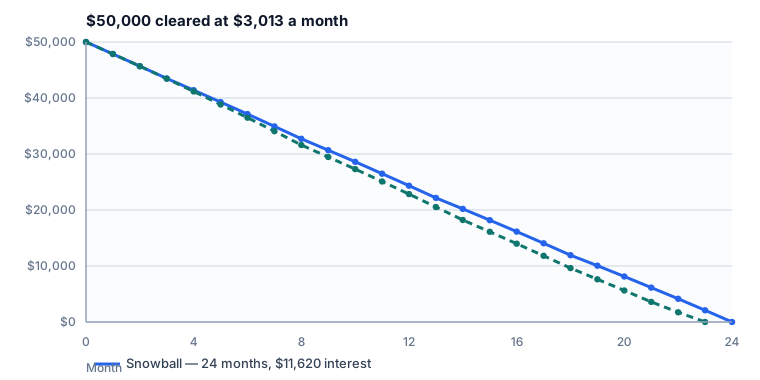
The two schedules overlap only at the very start and the very end, and the two-year horizon spreads them out far enough that each card gets its own month.
| Month | Snowball | Avalanche |
|---|---|---|
| 3 | Card E cleared ($5,500, 15%) | — |
| 8 | Card D cleared ($8,500, 17%) | Card A cleared ($15,000, 25%) |
| 13 | Card C cleared ($10,000, 20%) | — |
| 14 | — | Card B cleared ($11,000, 22%) |
| 18 | Card B cleared ($11,000, 22%) | Card C cleared ($10,000, 20%) |
| 21 | — | Card D cleared ($8,500, 17%) |
| 23 | — | Card E cleared ($5,500, 15%) — debt-free |
| 24 | Card A cleared ($15,000, 25%) — debt-free | — |
Avalanche leaves the $5,500 card at 15% for last, which is the cheapest thing on the list to leave open, and that is why it finishes a month early and $2,249.17 cheaper. Snowball leaves the 25% card running for the full two years, and that is what it pays for the early wins.
If your rates are higher than this
Rates move the second year's price more than they move the first year's, because the extra twelve months is time the balance spends accruing. The same portfolio and the same $3,013 a month, with every APR shifted three points in either direction — months shown are the snowball plan, and the last three columns are total interest and the gap between the two methods:
| APR range | Months | Snowball | Avalanche | Gap |
|---|---|---|---|---|
| 12-22% | 24 | $9,696.20 | $7,640.42 | $2,055.78 |
| 15-25% (as modelled) | 24 | $11,620.35 | $9,371.18 | $2,249.17 |
| 18-28% | 26 | $13,841.97 | $11,295.58 | $2,546.39 |
Three points of APR is worth about $1,924.15 in your favour or $2,221.62 against you on this plan. That is in the same league as the method choice itself, and slightly below it: the method gap on this two-year plan is $2,249.17, and on the one-year plan it is $1,030.64 — so both APR outcomes here are larger than the one-year method gap and just under the two-year one. It is also the one input on this page you can sometimes change without earning anything: a single call asking for a rate reduction on the $15,000 card moves this table.
How to actually free up $1,763 extra each month
$1,763 a month is $21,156 across the first year, and the same again across the second. At $25 an hour after tax that is about 846 hours a year, or roughly 16.3 extra hours a week; at $30 an hour it is 705 hours, or 13.6 a week. That is a part-time job held for two years, and the comparison that makes it tolerable is the alternative: the one-year plan asks for $3,873 a month above minimums instead, which is more than twice the rate and roughly 36 extra hours a week at $25 an hour.
- Fix the amount, not the intention. A payment this size does not survive being re-decided 24 times. Set the transfer for payday and treat the two-year plan as a bill rather than a goal.
- Attack the biggest non-card payment. Refinancing a $700 car payment down to $350 frees $350 a month with no change to your cards at all — a fifth of the requirement, from one phone call.
- Pause retirement contributions above the match. Redirecting $600 a month for two years frees $14,400, about 34% of what the plan needs above minimums. Keep contributing up to the employer match; that part is free money and stopping it is a real loss.
- Get the rate down on the largest card. As the table above shows, three points of APR is worth $1,924.15 to $2,221.62 on this plan — comparable to a year of extra shifts, and it takes one call.
- 0% balance transfer — the fee is small, the credit limit is not. A 3% to 5% fee on $50,000 is $1,500 to $2,500 against $11,620.35 of interest on the snowball plan, so the maths is tempting. The constraint is that very few single offers cover $50,000, so it means splitting across several promotional windows, each with its own fee and its own go-to rate when it closes. Anything still standing when a window closes starts accruing at the standard rate. Model it in the calculator before you apply.
One caution specific to this size. The two-year plan has less slack than the one-year plan, not more: adding $1,500 to the largest card pushes the snowball plan to 26 months — past the two-year line — while avalanche still lands in 24. Every number on this page assumes zero new charges.
Run your own numbers
Everything on this page came out of this site's API, so you can reproduce it or change it. The endpoint takes your cards and the extra you can pay:
POST https://debtsnowballtool.com/api/payoff
{
  "debts": [
    {"name":"Card A","balance":15000,"apr":25,"minPayment":375},
    {"name":"Card B","balance":11000,"apr":22,"minPayment":275},
    {"name":"Card C","balance":10000,"apr":20,"minPayment":250},
    {"name":"Card D","balance":8500,"apr":17,"minPayment":213},
    {"name":"Card E","balance":5500,"apr":15,"minPayment":137}
  ],
  "extra": 1763
}
Two things that trip people up: APR goes in as a percentage (25, not 0.25), and extra is the amount above your total minimums, not your total payment. Or just open the calculator and type your balances in — same engine, no payload.
If your balance is smaller, the same analysis at that size is in the $5K, $10K, $15K, $20K, $25K, $30K and $40K case studies, plus a 36-second walkthrough of the $25K case on YouTube. If your balance is larger, the $100K credit card debt case study runs the same engine at that size and measures where the first year's payments actually land. Shorter answers to the most common payoff questions live in the payoff questions hub.
Frequently asked questions
Can you pay off $50,000 in debt in 2 years?
Yes. With five cards totalling $50,000 at 15% to 25% APR, paying $3,013 a month clears the balance in 24 months on the snowball method and 23 months on the avalanche. Interest comes to $11,620.35 on snowball and $9,371.18 on avalanche.
How much do I have to pay each month to clear $50,000 in two years?
$3,013 a month at the start on the example portfolio — that is $1,763 on top of the $1,250 in minimum payments across the five cards. Avalanche reaches 24 months at $2,910 and snowball at $3,013, so the two methods cross the two-year line $103 apart.
What does the second year cost compared with paying it off in one year?
The one-year plan needs $5,123 a month and the two-year plan needs $3,013. The second year therefore takes $2,110 off the monthly payment — measured per month, every month — and adds $5,548.32 in interest — measured as extra interest totalled across all 24 payments. On those two footings the second year costs $2.63 of extra interest for every $1 of monthly relief.
What happens if I only pay the minimums on $50,000?
On the five-card example it takes 87 months, more than seven years, and costs $39,456.55 in interest on the snowball method. That is 78.9% of the original balance paid again in interest alone, and $89,456.55 in total. Avalanche does the same job in 85 months and $39,204.29 — and the entire 87-versus-85 difference is the last card.
Is it better to use the snowball or avalanche method on $50,000?
Avalanche is cheaper by $2,249.17 on the two-year plan and finishes a month earlier, in 23 months. Snowball finishes in 24 months and costs $11,620.35. The gap is larger here than on the one-year plan, where avalanche is $1,030.64 cheaper — a longer horizon gives the higher-rate balance more time to compound.
What if I can only pay $4,000 a month instead of $3,013?
$4,000 a month finishes ahead of the two-year target: 17 months on snowball at $8,130.35 in interest, 16 months on avalanche at $6,622.77. That is 70 months and about $31,000 cheaper than paying minimums only — so being unable to hit $5,123 does not put the one-year outcome out of reach, it just changes what it costs to get there.
Do I need to stop using the cards while paying them off?
Yes. Every number on this page assumes zero new charges. The two-year plan has less slack than the one-year plan for the same reason it is cheaper each month: adding $1,500 to the largest card pushes the snowball plan to 26 months, past the two-year line, while avalanche still lands in 24. A common trick is to remove the cards from your mobile wallet and freeze the physical cards so using one takes effort.
How many extra hours a week would clearing $50,000 in two years take?
You need $1,763 a month above minimums, which is $21,156 a year. At $25 an hour after tax that is about 846 hours a year, or roughly 16.3 extra hours a week. At $30 an hour it is about 705 hours, or 13.6 hours a week. The one-year plan asks for $3,873 a month above minimums instead — more than twice the rate.