Numbers from this site's public API on a 5-card $100,000 portfolio at 16-26% APR. Open the calculator with your own balances and rates and the same numbers come out in real time.
Where the first year's money actually goes
A payment plan is usually described by its finish line — 24 months, 12 months, debt-free. The first year is described by something else: of every dollar that leaves your account, how much of it is still yours afterwards, sitting in a balance that is smaller, and how much of it is gone. On a $100,000 balance at these rates that split is not close, and it is the number that decides whether a plan is working.
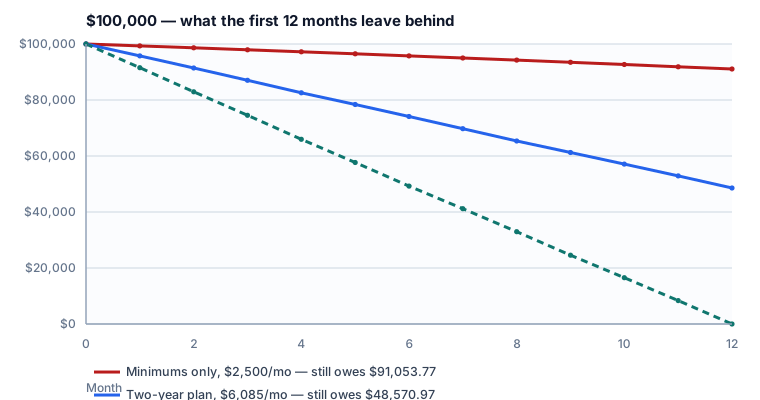
Three payment levels, one year, the same portfolio, all on the snowball method:
| Plan | Per month | Year-1 sent | To principal | To interest | Still owed (mo 12) |
|---|---|---|---|---|---|
| Minimums only | $2,500 | $30,000.00 | $8,946.23 29.82% | $21,053.77 70.18% | $91,053.77 |
| Two-year plan | $6,085 | $69,020.00 | $51,429.03 74.51% | $17,590.97 25.49% | $48,570.97 |
| One-year plan | $10,297 | $112,702.79 | $100,000.00 88.73% | $12,702.79 11.27% | $0.00 |
Both percentages in each row are measured against the same denominator — the total sent in year one on that row — so the two of them always add to 100%: 29.82% plus 70.18%, 74.51% plus 25.49%, 88.73% plus 11.27%. Neither share is measured against the $100,000 balance and neither is measured against the monthly payment. That matters because the monthly payment changes what the shares look like without changing what they are: the $2,500 row and the $6,085 row are the same debt, the same rates and the same twelve months, and the only thing that separates 29.82% from 74.51% is where the money was aimed.
The three rows also price the middle one. Moving from $2,500 to $6,085 sends $39,020 more across the year and cuts the year's interest from $21,053.77 to $17,590.97 — a saving of $3,462.80, which is 16.45% of the $21,053.77 you would have paid and 19.69% of the $17,590.97 you do pay. Read that as a rate and the extra cash returns 8.87 cents of interest saved per $1 sent — so the two-year plan is not buying you cheaper debt, it is buying you a smaller balance at the end of the year. The one-year plan is the only row where the year itself changes: interest falls to $12,702.79, which is $8,350.98 less than the minimums-only year, a 39.67% cut.
Why the two-year plan sends $69,020 and not $73,020
Take $6,085 and multiply by twelve and you get $73,020. The year does not cost that, and the reason is worth understanding because it repeats on every payoff plan. A card's minimum payment is part of your monthly total only while that card still has a balance. The month a card is cleared, its minimum drops out of the budget, and your required payment falls by that amount — so the money leaving your account steps down through the year instead of staying flat.
At $6,085 on this portfolio it steps down twice. The smallest card, $12,000 at 16%, is cleared in month 4, which takes $300 off the monthly payment; the $16,000 card at 18% goes in month 8, taking another $400. So the year is really $6,085 for four months, $5,785 for four and $5,385 for four, which is $69,020 — exactly $4,000 less than the flat multiplication. The $10,297 plan steps down four times, to $9,997, $9,597, $9,097 and finally $8,547, and lands at $112,702.79 instead of $123,564. Minimums-only is the one row that does not move at all: at $2,500 a month nothing on this portfolio is cleared inside the first year — the first card dies in month 58 — so the year really is $2,500 twelve times, and $30,000 is both the flat estimate and the truth.
There is a second consequence, and it is the one that makes the middle row interesting. Because the payment falls as cards die, the $69,020 is not $6,085 of effort twelve times over. It is $6,085 of effort at the start and $5,385 by the end, which is the plan getting easier at exactly the point most plans get abandoned. The finish line is month 24 either way; what changes is what the last quarter of it demands.
What minimums-only costs across the whole $100,000
Sending $2,500 a month — the minimums, nothing more — clears this portfolio in 94 months, which is 7.8 years, and interest comes to $88,986.65. That is 89.0% of the original balance paid a second time, in interest alone. The total bill is $188,986.65 for $100,000 of debt. Avalanche does the same job in 93 months and $88,631.63, so across nearly eight years the entire value of choosing the better order is $355.02.
The balance path explains why the first year feels so static. After 12 months of minimums you owe $91,053.77. After 24 months, $80,093.17. After 36 months, $66,649.75 — three years in and more than two thirds of the debt is still there. The last four years do almost all the work: the balance falls from $30,454.95 at month 60 to $6,223.91 at month 84, because by then most of the minimums are going to principal instead of interest. That is the shape of a minimum-payment plan — flat for years, then suddenly fast — and it is why the first-year share of 29.82% is the number to look at rather than the 94-month finish.
The three plans end to end
The three plans above are the ones the calculator produces for 36, 24 and 12 months, and each is worked through below on both methods.
- 36 months at $4,674 — $2,174 above the minimums. Snowball finishes in month 36 with $35,640.44 in interest; avalanche finishes in month 34 with $28,271.62. The gap is $7,368.82. Snowball's order is the $12,000 card in month 6, then $16,000 in month 12, $20,000 in month 19, $22,000 in month 26 and the $30,000 card last, in month 36.
- 24 months at $6,085 — $3,585 above the minimums. Snowball finishes in month 24 with $24,317.09; avalanche in month 23 with $19,735.39. The gap is $4,581.70. Avalanche kills the $30,000 card in month 8, then $22,000 in month 13, $20,000 in month 18, $16,000 in month 21 and $12,000 in month 23 — it leaves the cheapest card for last, which is why it wins.
- 12 months at $10,297 — $7,797 above the minimums. Both methods finish in month 12. Snowball pays $12,702.79 in interest, avalanche $10,594.47, so the gap is $2,108.32. At this speed the order barely matters: the whole balance is gone before compounding has time to punish the wrong sequence.
Notice how the method gap scales with the horizon rather than with the balance: $2,108.32 over a year, $4,581.70 over two, $7,368.82 over three, and then $355.02 across the full 94 months of minimums. The gap grows while you are paying aggressively and collapses when you are not, because the order only matters while there is spare money to concentrate.
Where the payment has to land
If you are working backwards from a target date, the payment is not a range — it is a number, and it is slightly different for each method. On this portfolio snowball reaches 36 months at $4,674, 24 months at $6,085 and 12 months at $10,297. Avalanche needs less for the same dates: $4,417, $5,860 and $10,122. The two are closest at the twelve-month end, $175 apart, and furthest apart at the three-year end, $257 apart.
The minimums are a large share of the two longer plans. At $4,674 they are 53.5% of the monthly payment; at $6,085 they are 41.1%; at $10,297 they are only 24.3%. So the three-year plan is mostly the payment you are already making, the one-year plan is mostly new money, and the two-year plan sits in between. That is also why the middle plan is the one most people actually hold: the extra money is real but the starting point is not zero.
How to free up $3,585 a month
The two-year plan needs $3,585 a month above minimums, which is $43,020 a year. At $25 an hour after tax that is about 33.1 extra hours a week; at $30 an hour it is about 27.6. The one-year plan needs $7,797 above minimums — $93,564 a year, or roughly 72 hours a week at $25 — which is why the 12-month plan is usually a windfall decision rather than a savings decision.
- Fix the amount, not the intention. A payment this size does not survive being re-decided 24 times. Set the transfer for payday and treat the plan as a bill rather than a goal.
- Attack the biggest non-card payment. Refinancing a $700 car payment down to $350 frees $350 a month with no change to your cards at all — nearly a tenth of the requirement, from one phone call.
- Pause retirement contributions above the match. Redirecting $600 a month for two years frees $14,400, a third of what the plan needs above minimums. Keep contributing up to the employer match; that part is free money and stopping it is a real loss.
- Get the rate down on the largest card. The $30,000 card carries 26% here. Three points off it is worth more than the same cut on any other card, because it is the largest balance at the highest rate — and it takes one call.
- 0% balance transfer — the fee is small, the limit is not. A 3% to 5% fee on $100,000 is $3,000 to $5,000 against $24,317.09 of interest on the 24-month snowball plan, so the arithmetic is tempting. The constraint is that very few single offers cover $100,000, so it means splitting across several promotional windows, each with its own fee and its own go-to rate when it closes. Anything still standing when a window closes starts accruing at the standard rate. Model it in the calculator before you apply.
One caution specific to this size. On a $100,000 balance a single new charge is not a rounding error: it is a new balance carrying 20%-plus interest, and it competes with the card you are currently attacking. Every number on this page assumes zero new charges.
Run your own numbers
Everything on this page came out of this site's API, so you can reproduce it or change it. The endpoint takes your cards and the extra you can pay:
POST https://debtsnowballtool.com/api/payoff
{
  "debts": [
    {"name":"Card A","balance":30000,"apr":26,"minPayment":750},
    {"name":"Card B","balance":22000,"apr":23,"minPayment":550},
    {"name":"Card C","balance":20000,"apr":21,"minPayment":500},
    {"name":"Card D","balance":16000,"apr":18,"minPayment":400},
    {"name":"Card E","balance":12000,"apr":16,"minPayment":300}
  ],
  "extra": 3585
}
Two things that trip people up: APR goes in as a percentage (26, not 0.26), and extra is the amount above your total minimums, not your total payment — $3,585 here, which is what turns the $2,500 in minimums into $6,085 a month. Or just open the calculator and type your balances in — same engine, no payload.
If your balance is smaller, the same analysis at that size is in the $5K, $10K, $15K, $20K, $25K, $30K, $40K and $50K case studies, plus a 36-second walkthrough of the $25K case on YouTube. Shorter answers to the most common payoff questions live in the payoff questions hub.
Frequently asked questions
How much do I have to pay a month to clear $100,000 in credit card debt?
On the five-card example here, $4,674 a month clears it in 36 months, $6,085 clears it in 24 months and $10,297 clears it in 12 months on the snowball method. The minimums on the same portfolio come to $2,500, so the three plans need $2,174, $3,585 and $7,797 above minimums respectively.
If I only pay the minimums on $100,000, how much of the money actually reduces the debt?
In the first year, $8,946.23 of it. The minimums send $30,000 across twelve months, and $8,946.23 — 29.82% — reaches principal while $21,053.77 — 70.18% — goes to interest. Both shares use the same denominator: the $30,000 sent in year one, not the $100,000 balance and not the $2,500 monthly payment. After twelve months of minimums you still owe $91,053.77.
Why does the first year at $6,085 cost $69,020 and not $73,020?
Because the total payment steps down as cards are cleared. Each card's minimum disappears from the monthly budget the month that card is paid off, so the $6,085 is really $6,085 for four months, $5,785 for four and $5,385 for four — $69,020 in total, which is $4,000 less than multiplying the starting payment by twelve. The same effect takes the $10,297 plan to $112,702.79 instead of $123,564.
What does minimums-only cost across the whole $100,000?
94 months, which is 7.8 years, and $88,986.65 in interest on the snowball method. That is 89.0% of the original balance paid again in interest alone, and a total bill of $188,986.65. Avalanche does the same job in 93 months and $88,631.63 — a gap of just $355.02 across nearly eight years, which is what happens when proportional payments leave almost nothing to concentrate.
Is the snowball or the avalanche method better on $100,000?
The gap grows with the horizon. Avalanche is $2,108.32 cheaper on the 12-month plan, $4,581.70 cheaper on the 24-month plan and $7,368.82 cheaper on the 36-month plan. At minimums the two methods are $355.02 apart. Longer, more aggressive plans give the higher-rate balance more time to compound, so getting the order right is worth more the faster you are paying.
Can you pay off $100,000 in credit card debt in one year?
Yes, at $10,297 a month on the example portfolio — $7,797 above the $2,500 in minimums. That is $93,564 a year of extra money, about 72 hours a week at $25 an hour after tax. It finishes in month 12 on both methods, with $12,702.79 in interest on snowball and $10,594.47 on avalanche.
How many extra hours a week does clearing $100,000 in two years take?
The 24-month plan needs $3,585 a month above minimums, which is $43,020 a year. At $25 an hour after tax that is about 33.1 extra hours a week; at $30 an hour it is about 27.6. The one-year plan asks for $7,797 above minimums instead, or about 72 hours a week at $25.
Do I need to stop using the cards while paying off $100,000?
Yes. Every number on this page assumes zero new charges, and at this size the margin for new spending is thin: the 24-month plan clears the smallest card in month 4 and the last one in month 24, and a single new balance added to the largest card pushes the finish past the two-year line. A common approach is to remove the cards from your mobile wallet and freeze the physical ones so using one takes deliberate effort.