Numbers from this site's public API on a 4-card $25,000 portfolio at 16-24% APR. Open the calculator with your own balances and rates and the same numbers come out in real time.
The example portfolio
Every number on this page comes from the four-card stack below — $25,000 spread across rates from 16% to 24%, with the largest balance also carrying the highest rate. That combination is what lets avalanche pull ahead here, and it is also the most common shape a $25,000 balance actually takes: one big card near its limit, three smaller ones behind it.
| Card | Balance | Min payment | APR |
|---|---|---|---|
| Card A | $9,000 | $225 | 24% |
| Card B | $7,000 | $175 | 22% |
| Card C | $5,000 | $125 | 19% |
| Card D | $4,000 | $100 | 16% |
| Total | $25,000 | $625 | — |
What minimums-only actually costs on $25,000
Sending $625 a month — the minimums, nothing more — clears this portfolio in 81 months on both methods, which is nearly seven years. Interest comes to $19,718.70 on snowball and $19,715.58 on avalanche, a difference of three dollars. You repay the $25,000 and then pay another 79% of it again in interest.
So the honest framing is not "I need $2,700 a month." It is "the gap between doing nothing extra and doing the one-year plan is $16,875.35 in interest and 69 months." Against that, the $408.75 that avalanche saves you is 2.4% of the money and one month of the time. The payment size is worth about 41 times more than the method choice.
At $25,000 the method stops being a tie
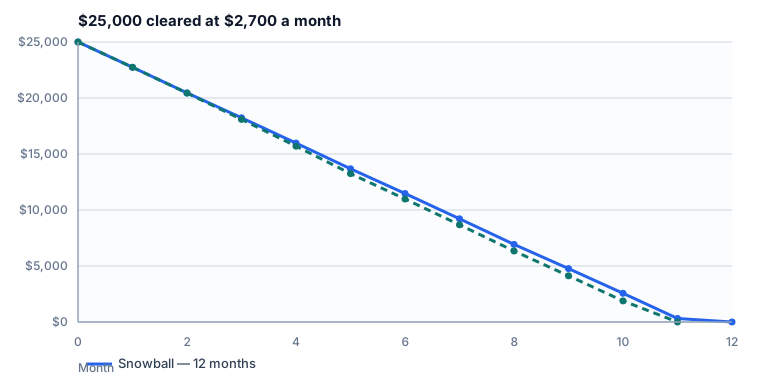
On smaller balances the two methods land on the same month and differ only in the interest bill. Here they do not. At $2,700 a month snowball needs 12 months and avalanche needs 11 — avalanche wins on both the calendar and the interest, which is the first time in this series that the method choice changes when you become debt-free rather than just what you pay for it.
| Method | Payoff order | Months | Total interest |
|---|---|---|---|
| Snowball | D (m2) → C (m5) → B (m8) → A (m12) | 12 | $2,843.35 |
| Avalanche | A (m5) → B (m8) → C (m10) → D (m11) | 11 | $2,434.60 |
Why the divergence? Because the 24% card is also the biggest one, at $9,000. Avalanche attacks $9,000 at 24% first; snowball spends its first months clearing $4,000 at 16% and $5,000 at 19% instead. On a smaller stack the balance gap between the cards is narrow enough that the order barely matters. Widen that gap — bigger balance, higher rate, same card — and the ordering starts to compound into whole extra months.
Where each card dies, month by month
Snowball still delivers its early win — the $4,000 card is gone at month 2, three months before avalanche kills its first one. But on this portfolio that head start is not enough to buy back the time, because the card snowball leaves for last is $9,000 at 24%.
| Month | Snowball | Avalanche |
|---|---|---|
| 2 | Card D cleared ($4,000, 16%) | — |
| 5 | Card C cleared ($5,000, 19%) | Card A cleared ($9,000, 24%) |
| 8 | Card B cleared ($7,000, 22%) | Card B cleared ($7,000, 22%) |
| 10 | — | Card C cleared ($5,000, 19%) |
| 11 | — | Card D cleared ($4,000, 16%) — debt-free |
| 12 | Card A cleared ($9,000, 24%) — debt-free | — |
What if you can't free up $2,075 a month?
Then this becomes a 15-month, a 19-month or a 27-month plan, and all three are still far better than 81 months. The curve is steepest at the bottom: the first $375 above minimums cuts 36 months off the timeline. The last $150 before the one-year mark buys no months at all — snowball already reaches 12 months at $2,550, so the final $150 up to $2,700 only saves about $181 in interest.
| Total monthly | Months (snowball) | Months (avalanche) | Interest (snowball) | Interest (avalanche) |
|---|---|---|---|---|
| $625 (minimums) | 81 | 81 | $19,718.70 | $19,715.58 |
| $1,000 | 45 | 41 | $10,479.20 | $8,423.60 |
| $1,200 | 34 | 32 | $7,883.23 | $6,525.14 |
| $1,400 | 27 | 26 | $6,364.21 | $5,258.38 |
| $1,600 | 22 | 21 | $5,324.27 | $4,441.26 |
| $1,800 | 19 | 19 | $4,550.24 | $3,876.63 |
| $2,000 | 17 | 16 | $4,020.21 | $3,397.15 |
| $2,200 | 15 | 15 | $3,584.61 | $3,052.71 |
| $2,400 | 13 | 13 | $3,244.07 | $2,786.45 |
| $2,600 | 12 | 12 | $2,975.85 | $2,545.46 |
| $2,700 | 12 | 11 | $2,843.35 | $2,434.60 |
| $3,000 | 10 | 10 | $2,540.42 | $2,194.11 |
Note the $1,000-a-month row: snowball takes 45 months, avalanche takes 41 — a four-month gap worth $2,055.60. That is five times the gap at the one-year payment. Low payments give the rate ordering years to compound; high payments finish before it can. If you can only manage $1,000 a month on $25,000, the method you pick matters far more than it does at $2,700.
How to actually free up $2,075 extra each month
Be straight about the scale: $2,075 a month is $24,900 across the year, about 996 hours at $25/hour after tax, or 19 extra hours a week for 52 weeks. That is not a side hustle, it is a second job — which is why at this balance size the plan almost always includes a lump sum. People who clear $25,000 in twelve months typically stack from the top of this list:
- A significant asset sale. A second car, a truck, a boat, a motorcycle collection, unused equipment. $8,000 to $12,000 in month one is a third to a half of the whole year's requirement, and a lump in month one does more damage to the interest curve than the same money spread out.
- A fixed-term income push. Overtime, weekend shifts, a second job, contract work — twelve months with a hard end date. At $25/hour after tax, 15 extra hours a week is about $1,600 a month.
- Pause retirement contributions above the match. Redirecting $600 a month for one year costs you one year of contributions and saves roughly $16,875 in interest. Keep contributing at least up to the match — that part is free money.
- Refinance or downsize the biggest non-card payment. On a $25,000 debt load, an auto loan payment is often larger than every card minimum combined. Cutting a $550 car payment to $350 frees $200 a month for a year without touching the cards.
- A 0% balance transfer, only if the math clears. A 3% to 5% fee on $25,000 is $750 to $1,250 — two to three times the $408.75 the method choice is worth, and more than four months of avalanche's interest saving. It has to save you more than its own fee. Model it in the calculator before you apply.
Two cautions. First, none of this works if new charges keep landing on the cards; a one-year plan assumes the balance only moves in one direction. Second, if your APRs run higher than the 16-24% range used here — and store cards often sit at 29% or more — every month figure above gets longer and every interest figure gets bigger. Rerun it with your real numbers instead of borrowing these.
Run your own numbers
Everything on this page came out of this site's API, so you can reproduce it or change it. The endpoint takes your cards and the extra you can pay:
POST https://debtsnowballtool.com/api/payoff
{
  "debts": [
    {"name":"Card A","balance":9000,"apr":24,"minPayment":225},
    {"name":"Card B","balance":7000,"apr":22,"minPayment":175},
    {"name":"Card C","balance":5000,"apr":19,"minPayment":125},
    {"name":"Card D","balance":4000,"apr":16,"minPayment":100}
  ],
  "extra": 2075
}
Two things that trip people up: APR goes in as a percentage (24, not 0.24), and extra is the amount above your total minimums, not your total payment. Or just open the calculator and type your balances in — same engine, no payload.
The same analysis exists at $10K, $15K, $20K and $30K. Short answers to the most common payoff questions are in the payoff questions hub.
Frequently asked questions
Can you pay off $25,000 in debt in 1 year?
Yes. With four cards totalling $25,000 at 16% to 24% APR, paying $2,700 a month clears the balance in 12 months on the snowball method and 11 months on avalanche. Interest comes to $2,434.60 on avalanche and $2,843.35 on snowball.
How much do I have to pay each month to clear $25,000 in a year?
$2,550 a month gets snowball to 12 months on the example portfolio; at $2,700 both methods finish inside the year, with avalanche at 11 months. That is $2,075 above the $625 in minimum payments across the four cards.
What happens if I only pay the minimums on $25,000?
On the four-card example it takes 81 months, which is nearly seven years, and costs $19,718.70 in interest on the snowball method. That is 79% of the original balance paid again in interest alone.
Is it better to use the snowball or avalanche method on $25,000?
Avalanche wins on both counts at this size: 11 months instead of 12, and $408.75 less interest. On smaller balances the two methods tie on the finish line, so $25,000 is the point where the method choice starts moving the calendar, not just the interest bill.
Should I use a 0% balance transfer to pay off $25,000 faster?
Only if you can move most of the balance and clear it inside the promotional window. The transfer fee usually runs 3% to 5%, which is $750 to $1,250 on $25,000 — two to three times the method gap. Run both scenarios in the calculator before you apply.
Do I need to stop using the cards while paying them off?
Yes. Every number on this page assumes zero new charges. If you keep spending on the cards, the balances stop shrinking no matter how much extra you send. A common trick is to remove the cards from your mobile wallet and freeze the physical cards so using one takes effort.
How many hours of overtime would it take to clear $25,000 in a year?
You need $2,075 a month above minimums, which is $24,900 across the year. At $25 an hour after tax that is about 996 hours, or 19 extra hours a week for 52 weeks. At this size almost nobody clears it on hours alone — an asset sale is usually the bigger half of the plan.