Numbers from this site's public API on a 3-card $5,000 portfolio at 18-26% APR. Open the calculator with your own balances and rates and the same numbers come out in real time.
The example portfolio
"Can I pay off $5,000 in a year" sounds like a small question, and it is the smallest one in this series — but it is also the one where the arithmetic is least forgiving, because the minimum payments already eat 29% of the one-year payment. The example below uses three US credit cards, with the rates stacked so the smallest balance is not the most expensive one. That is the shape that makes the snowball-versus-avalanche argument worth checking at all.
| Card | Balance | Min payment | APR |
|---|---|---|---|
| Card A | $2,000 | $60 | 26% |
| Card B | $1,750 | $50 | 21% |
| Card C | $1,250 | $40 | 18% |
| Total | $5,000 | $150 | — |
Card C is the smallest and the cheapest. Card A is the largest and the most expensive. Snowball goes after C first because it is small. Avalanche goes after A first because it is expensive. Both reach zero in month 12 here — so the method argument is real but thin, and the numbers below show exactly how thin.
What minimums-only actually costs on $5,000
This is the number that rarely gets printed next to the one-year headline. Sending $150 a month — the minimums, nothing more — clears this portfolio in 59 months, which is almost five years. Interest comes to $3,007.87 on snowball and $3,006.48 on avalanche. You repay the $5,000 and then pay another 60% of it again in interest. The lever that fixes it is the payment size, not the order: on a single $5,000 card at 24%, $50 on top of the minimum takes 82 months down to 43.
But there is a second finding here that matters more, and it is unusual. At the minimums-only payment the two methods are not merely close — they are identical. Same payoff order, same month, same $1.39 difference. Snowball clears Card C at month 43, then B at 55, then A at 59. Avalanche does exactly the same thing, in the same months.
That is not a coincidence and it is worth understanding. Minimum payments are set as a percentage of each balance, so every card gets paid down in proportion and nothing is ever focused. The method is a rule about where to send extra money. When there is no extra money, there is nothing for the rule to act on. If you are paying minimums and agonising over snowball versus avalanche, you are choosing between two identical plans.
Both methods finish in 12 months at $515/month
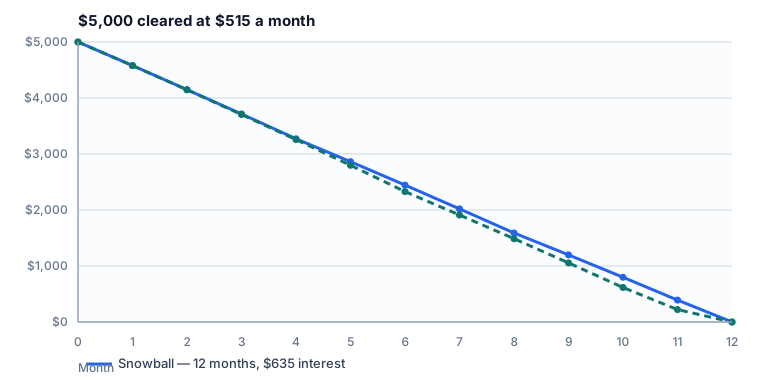
At $515 a month the payoff orders finally diverge, and they diverge properly: snowball kills the $1,250 card first, avalanche goes straight at the 26% card. Both finish at month 12. Avalanche costs $95.93 less.
| Method | Payoff order | Months | Total interest |
|---|---|---|---|
| Snowball | C (m4) → B (m8) → A (m12) | 12 | $634.84 |
| Avalanche | A (m6) → B (m10) → C (m12) | 12 | $538.91 |
Here is the part most method arguments skip. On this portfolio, choosing avalanche over snowball is worth $95.93. Going from minimums to $515 a month is worth $2,373.03 and 47 months. The payment size is about 25 times more powerful than the method. If you are arguing about card order while your monthly payment stays flat, you are optimising the wrong variable — and at $5,000 that mistake is proportionally the cheapest one to make, because the whole balance is small.
Where each card dies, month by month
The psychological case for snowball is the early win, and at $5,000 that win is late. The first card does not fall until month 4 — there is no month-1 or month-2 kill available here, because the $150 in minimums absorbs most of the payment before any extra money gets aimed anywhere. Avalanche's first card takes six months because it is the $2,000 balance.
| Month | Snowball | Avalanche |
|---|---|---|
| 4 | Card C cleared ($1,250, 18%) | — |
| 6 | — | Card A cleared ($2,000, 26%) |
| 8 | Card B cleared ($1,750, 21%) | — |
| 10 | — | Card B cleared ($1,750, 21%) |
| 12 | Card A cleared ($2,000, 26%) — debt-free | Card C cleared ($1,250, 18%) — debt-free |
Notice which card avalanche leaves for last: the $1,250 one at 18%, the cheapest card on the list. Leaving the cheapest card open for twelve months is the least expensive thing you can leave open. Snowball does the opposite and leaves the 26% card open all year, which is precisely why it costs an extra $95.93.
What if you can't free up $365 a month?
Then the plan becomes a 17-month, a 25-month or a 32-month plan — all of them still dramatically better than 59. The curve is steepest at the bottom: the first $50 above minimums cuts 14 months off the timeline.
| Total monthly | Months (snowball) | Months (avalanche) | Interest (snowball) | Interest (avalanche) |
|---|---|---|---|---|
| $150 (minimums) | 59 | 59 | $3,007.87 | $3,006.48 |
| $200 | 45 | 39 | $2,169.86 | $1,775.40 |
| $250 | 32 | 30 | $1,577.85 | $1,301.61 |
| $300 | 25 | 24 | $1,241.90 | $1,027.28 |
| $350 | 20 | 19 | $1,008.88 | $843.31 |
| $400 | 17 | 16 | $855.14 | $716.25 |
| $450 | 15 | 14 | $749.07 | $633.47 |
| $500 | 13 | 13 | $659.39 | $557.77 |
| $515 | 12 | 12 | $634.84 | $538.91 |
| $540 | 12 | 12 | $606.96 | $516.67 |
| $600 | 10 | 10 | $538.36 | $459.72 |
Two things to read off this table. First, the one-year line: avalanche gets there at $505, snowball at $515. At $510 you are one month away on snowball and already inside the year on avalanche — a single month of divergence, worth $97.55. Second, the method gap is not biggest at the one-year payment. It is biggest in the messy middle: at $175 a month the two methods split by eight months and $404.68, four times the gap at $515. At minimums it is $1.39; at $515 it is $95.93; at $175 it is $404.68. If you are paying meaningfully more than the minimum but nowhere near enough to finish fast, the method is the one lever you actually control.
How to actually free up $365 extra each month
$5,000 is the size where this is a project rather than a lifestyle change. $365 a month is $4,380 across the year, and at $20 an hour after tax that is about 219 hours — roughly 4.2 extra hours a week for 52 weeks. That is one weekend shift, not a second job. In practice people assemble it from a mix, usually from the top of this list:
- Sell one thing. A single $1,000 sale covers almost a quarter of the whole year's requirement, and it arrives as a lump you can throw at the first card in month one — the month where a lump does the most damage to the interest curve. At $5,000 a lump matters more than it does at $25,000, because it is a larger share of the balance.
- Four or five extra hours a week. At $20 an hour after tax, 4.2 hours a week covers the full $365. That is the entire requirement, with a fixed end date twelve months out.
- Pause retirement contributions above the match. Redirecting $150 a month for one year frees $1,800 — 41% of what the year needs — at the cost of one year of contributions. Keep contributing at least up to the match; that part is free money.
- Attack the biggest non-card payment. Cutting a $400 car payment to $250 frees $150 a month with no change to your cards at all. On a $5,000 plan that one move is 41% of the requirement.
- A 0% balance transfer — this is the one size where it can win. A 3% to 5% fee on $5,000 is $150 to $250, against $634.84 of interest on the snowball plan. Unlike at $10,000 or $25,000, the fee is smaller than the interest, so the transfer can genuinely come out ahead. It only does so if the entire balance is gone before the promotional window closes; anything left over gets the go-to rate, and the fee plus that interest usually wipes out the gain. Model it in the calculator before you apply.
Two cautions. First, none of this works if new charges keep landing on the cards, and at $5,000 the margin is thinner than at larger balances — putting just $300 more on the same cards turns the 12-month plan into a 13-month one. Second, if your APRs are higher than the 18-26% range used here — and store cards often run 29% or more — every month figure above gets longer and every interest figure gets bigger. Rerun it with your real numbers instead of borrowing these.
Run your own numbers
Everything on this page came out of this site's API, so you can reproduce it or change it. The endpoint takes your cards and the extra you can pay:
POST https://debtsnowballtool.com/api/payoff
{
  "debts": [
    {"name":"Card A","balance":2000,"apr":26,"minPayment":60},
    {"name":"Card B","balance":1750,"apr":21,"minPayment":50},
    {"name":"Card C","balance":1250,"apr":18,"minPayment":40}
  ],
  "extra": 365
}
Two things that trip people up: APR goes in as a percentage (26, not 0.26), and extra is the amount above your total minimums, not your total payment. Or just open the calculator and type your balances in — same engine, no payload.
If your balance is bigger than $5,000, the same analysis at that size is in the $10K in 1 year case study. There are also $15K, $20K, $25K, $30K and $40K versions, plus a 36-second walkthrough of the $25K case on YouTube. Shorter answers to the most common payoff questions live in the payoff questions hub.
Frequently asked questions
Can you pay off $5,000 in debt in 1 year?
Yes. With three cards totalling $5,000 at 18% to 26% APR, paying $515 a month clears the balance in 12 months on both the snowball and the avalanche method. Interest comes to $538.91 on avalanche and $634.84 on snowball.
How much do I have to pay each month to clear $5,000 in a year?
$515 a month total on the example portfolio. That is $365 on top of the $150 in minimum payments across the three cards. The snowball method crosses into 12 months somewhere between $510 and $515 — at $510 it still needs 13 months — while avalanche gets there at $505.
What happens if I only pay the minimums on $5,000?
On the three-card example it takes 59 months, which is almost five years, and costs $3,007.87 in interest on the snowball method. That is 60% of the original balance paid again in interest alone. At that payment level the two methods are not just close but identical: same payoff order, same month, $1.39 apart.
Is it better to use the snowball or avalanche method on $5,000?
Avalanche is cheaper by $95.93 over the 12 months on this portfolio. That is real money but it is small next to the payment size: going from minimums to $515 a month saves $2,373.03, which is about 25 times more than the method choice is worth. The exception is the $175-a-month range, where the gap opens to $404.68 and eight months.
Should I use a 0% balance transfer to pay off $5,000 faster?
It can win here, unlike at larger balances. The transfer fee usually runs 3% to 5%, which is $150 to $250 on $5,000, against $634.84 of interest on the snowball plan. But it only wins if the whole balance is gone before the promotional window closes — any remainder gets the go-to rate, and the fee plus that interest usually erases the gain. Run both scenarios in the calculator before you apply.
Do I need to stop using the cards while paying them off?
Yes. Every number on this page assumes zero new charges. At $5,000 the margin is thinner than at larger balances: putting $300 more on the same cards turns the 12-month plan into a 13-month one. A common trick is to remove the cards from your mobile wallet and freeze the physical cards so using one takes effort.
How many hours of overtime would it take to clear $5,000 in a year?
You need $365 a month above minimums, which is $4,380 across the year. At $20 an hour after tax that is about 219 hours, or roughly 4.2 extra hours a week for 52 weeks. At $25 an hour it is about 175 hours, or 3.4 hours a week.