Numbers from this site's public API on a 3-card $5,000 portfolio at 18-26% APR. The per-card figures come from the API's own perDebt breakdown. Open the calculator with your own balances and rates and the same numbers come out in real time.
The example portfolio
"Can I pay off $5,000 in six months" is the smallest question in this series, and it is the one where the answer is decided by cash flow rather than by arithmetic. This page uses three US credit cards totalling $5,000, the same three-card shape as the $5K in 1 year case study so the two can be read side by side. Card A carries $2,000 at 26% APR with a $60 minimum; Card B carries $1,750 at 21% with a $50 minimum; Card C carries $1,250 at 18% with a $40 minimum. The three minimums add up to $150 a month.
To clear all three in six months, the snowball method needs $934 a month, which is $784 above the minimums. Avalanche needs less — $923 — because it goes straight at the 26% card. Both land in month 6, and the snowball threshold is exact: at $933 the same portfolio takes seven months. Every figure on this page is for the snowball plan unless it says otherwise.
Where the $934 a month actually comes from
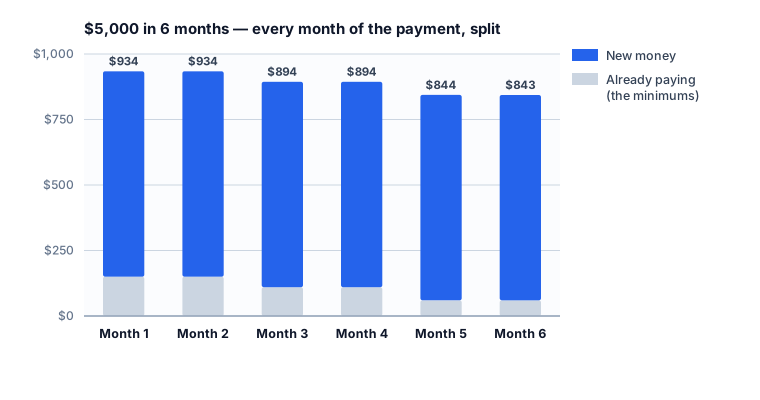
Six months at this pace means sending $5,343.42. Only one part of that is money you are already moving today, and the split is the whole story of this page:
| Part of the payment | Month 1 | Six months | Share of total |
|---|---|---|---|
| Already paying the minimums | $150 | $640 | 11.98% |
| New money you have to find | $784 | $4,703.42 | 88.02% |
| Leaves your account | $934 | $5,343.42 | 100.00% |
The first row is the part that moves, and it is the reason the monthly total falls. $150 is not a fixed monthly minimum — it is the sum of the minimums on the cards that are still open, so it drops every time a card falls: Card C goes in month 2, Card B in month 4, and from month 5 there is only Card A left at $60. Your own $784 never moves. Six payments of $934 would be $5,604, and you will not send $5,604 — the six months cost $5,343.42, and the whole $260.58 difference is the shrinking minimums line.
Read the two shares in the subhead together, because they are measured against two different things. The 88.02% is $4,703.42 divided by the $5,343.42 that leaves your account — how much of the money you will send is money you are not sending now. The 94.07% is $4,703.42 divided by the original balance of $5,000 — how much of the debt has to be funded out of money that does not exist in your budget yet. Neither share is measured against the monthly payment, and the gap between them is entirely the interest.
What the six months cost the bank
On the same portfolio the interest bill is $343.42 on the snowball method and $299.08 on the avalanche, a gap of $44.34. Put next to the $4,703.42 you have to find, the interest is small — $13.70 of new money for every $1 of interest. That is the opposite of what most payoff advice assumes: at $5,000 the arithmetic is not the obstacle.
The per-card split is still worth knowing, because it is where the $44.34 hides. Card A, the $2,000 balance at 26%, carries $224.43 of the $343.42 interest — 65.35% of it, on 40.00% of the debt. Card B carries $93.57 and Card C carries $25.42. Per $1,000 of balance that is $112.22 on the 26% card against $20.34 on the 18% card, a factor of 5.52. Card A is also the last card cleared, in month 6, while the $1,250 card at 18% is gone by month 2.
Switch the method and the same six months look different on that one card: under avalanche Card A is cleared first, in month 3, and costs $77.58 instead of $224.43 — a difference of $146.85 on a single card. The other two cards pay slightly more under avalanche, which is why the total gap is only $44.34. Nothing else about the debt changes; the balance, the rates and the six months are identical.
The same six months, on minimums only
Sending $150 a month clears this portfolio in 59 months — almost five years — and costs $3,007.87 in interest, a total bill of $8,007.87. The six-month plan's $343.42 is 11.42% of that, a saving of $2,664.45.
The comparison over the same six months is sharper than the comparison over the whole term. Six months of minimums retires $359.41 of principal and leaves $4,640.59 still owed; six months of the $934 plan retires all $5,000. The same $5,343.42 either ends the debt or barely dents it, depending only on the size of the payment.
Where the $784 comes from
This is the part that decides whether the plan happens, so it is worth stating plainly: you need $784 a month above the $150 you already pay, for six months, which is $4,703.42 in total and 94.07% of the balance. At $20 an hour after tax that is about 9.0 extra hours a week; at $25 an hour, 7.2; at $30, 6.0.
Two things make it easier than the number looks. The minimums line falls by $90 between month 1 and month 5, so if a card payment is freed up you can leave it in the plan and it does the work of a raise. And the deadline is forgiving in a way the interest is not: drop to $650 a month and the plan takes 10 months and costs $494.29 instead of $343.42 — the four missing months cost $150.87, which is real money but not a catastrophe.
Reproduce these numbers
Every figure on this page comes from this site's public API. Post the three balances, their rates, their minimums and extra: 784 to /api/payoff and you get the same months, the same $343.42 and the same per-card breakdown. Two things that trip people up: APR goes in as a percentage (26, not 0.26), and extra is the amount above your total minimums, not your total payment — $784 here, which is what turns the $150 in minimums into $934 a month. The response's perDebt array is where the per-card interest figures come from: each card's interest, principal and clearedMonth, and those interest figures sum to the plan's totalInterest. Or just open the calculator and type your balances in — same engine, no payload.
If your target is a different size or a different deadline, the same analysis is in the $5K in 1 year, $10K, $10K in 6 months, $15K, $15K in 6 months, $20K, $25K, $30K, $40K, $50K and $100K case studies, plus a 36-second walkthrough of the $25K case on YouTube. Shorter answers to the most common payoff questions live in the payoff questions hub.
Frequently asked
How much do I have to pay a month to clear $5,000 in six months?
On the three-card example here, $934 a month clears the $5,000 in six months on the snowball method, which is $784 above the $150 in minimums. Avalanche needs less — $923 — because it goes at the 26% card first. Both land in month 6, and at $933 the snowball plan slips to seven months.
How much interest do I pay on $5,000 over six months?
$343.42 on the snowball method and $299.08 on the avalanche, a gap of $44.34. The interest is 6.87% of the original $5,000. The total that leaves your account over the six months is $5,343.42 on snowball — the $5,000 balance plus $343.42 of interest.
Is 88% of the payment really money I am not paying today?
Yes. Across the six months you send $5,343.42, and $4,703.42 of that is money above the minimums — 88.02%. The other $640 is the minimum payments you are already making. The two percentages on this page use two different denominators: 88.02% against the $5,343.42 that leaves your account and 94.07% against the original balance of $5,000, and neither is against the monthly payment.
Why is the payment $934 in month 1 and less later on?
Because the minimums line is the sum of the minimums on the cards that are still open, so it shrinks every time a card falls. Card C is cleared in month 2 and Card B in month 4, which takes $40 and $50 out of the monthly total, so the plan is really $934 twice, $894 twice, $844 once and $843.42 to finish — $5,343.42 in total, which is $260.58 less than multiplying the starting payment by six.
Which of the three cards costs the most?
Card A, the $2,000 balance at 26%. It carries $224.43 of the plan's $343.42 interest, which is 65.35%, on 40.00% of the balance. Per $1,000 of balance the three cards cost $112.22, $53.47 and $20.34 — the 26% card costs 5.52 times what the 18% card costs. Card A is also the last card cleared, in month 6, while the $1,250 card at 18% goes first, in month 2.
Does snowball versus avalanche matter on $5,000?
It is worth $44.34 over the six months, which is 12.91% of the interest bill. Avalanche pays $299.08 and snowball pays $343.42. Nearly all of the gap sits on one card: Card A costs $224.43 under snowball because it is cleared last and $77.58 under avalanche because it is cleared first, a difference of $146.85 that the other two cards partly give back.
What if I only pay the minimums on $5,000?
The $150 in minimums clears the balance in 59 months — almost five years — and costs $3,007.87 in interest, a total bill of $8,007.87. Over the same six months the minimums retire only $359.41 of principal and leave $4,640.59 still owed. The six-month plan's $343.42 is 11.42% of the minimums-only interest, a saving of $2,664.45.
What if I can only find $500 of new money instead of $784?
Then the payment is $650 a month and the snowball plan takes 10 months instead of six, with $494.29 in interest — $150.87 more than the six-month plan. Avalanche finishes in 9 months at $426.14. The interest cost of missing the six-month deadline by four months is $150.87, which is 43.93% of the six-month interest bill, while the method choice at that payment is worth only $68.15.