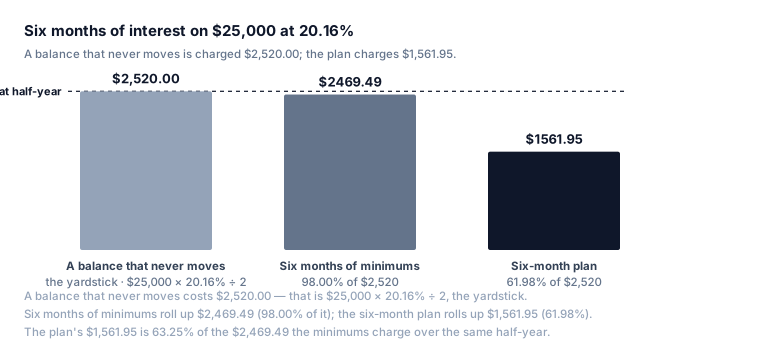
Numbers from this site's public API on a four-card $25,000 portfolio at 16-24% APR. The $2,520.00 reference is arithmetic, not an API output: $25,000 × 20.16% ÷ 2. Open the calculator with your own balances and rates and the rest comes out in real time.
The example portfolio
"Can I pay off $25,000 in six months" is the size where the monthly payment stops being a number you can find in a budget and becomes a number you have to construct. This page uses four US credit cards totalling $25,000 — the same four-card shape as the $25K in 1 year and $25K in 2 years case studies, so the three pages can be read side by side. Card A carries $8,000 at 24% APR with a $200 minimum; Card B $7,000 at 20% with a $175 minimum; Card C $6,000 at 18% with a $150 minimum; Card D $4,000 at 16% with a $100 minimum. The four minimums add up to $625 a month.
The four APRs run a clean ladder from 24% down to 16%, and that matters for one number used all over this page: weighted by balance, the portfolio's rate is 20.16% a year — $8,000 × 24%, $7,000 × 20%, $6,000 × 18% and $4,000 × 16% come to $5,040.00 of annual interest on a $25,000 balance. One twelfth of that is 1.6800%, which on the opening balance is $420.00 for the first month — $160.00 on Card A, $116.67 on Card B, $90.00 on Card C and $53.33 on Card D, $420.00 in all.
To clear all four in six months, the snowball method needs $4,625 a month, which is $4,000 above the minimums. Avalanche needs slightly less — $4,587 — because it goes straight at the 24% card. Both land in month 6, and the thresholds are exact: at $4,614 the snowball plan slips to seven months. The two cliffs are only $28 apart ($4,615 for snowball, $4,587 for avalanche), so the method you pick barely changes the check you have to write to finish in half a year. Every figure on this page is for the snowball plan unless it says otherwise.
What your first payment is made of
Everyone expects a debt payment to be mostly interest at the start. On this portfolio the first payment is the opposite. Send $4,625 in month 1 and the 20.16% rate charges $420.00 of it — so $4,205.00 is principal, which is 90.92% of the payment. The share climbs every month after that, because the interest falls as the balance falls: 91.97% in month 2, 93.36% in month 3, 94.67% in month 4, 96.25% in month 5 and 98.04% in month 6, when the interest is down to $81.12. You are buying the balance from the very first payment, not renting it — the only reason the share is not higher is that the six-month window is too short for the 20.16% rate to compound.
| Month | The payment | Interest | Goes to principal | % of the payment |
|---|---|---|---|---|
| Month 1 | $4,625.00 | $420.00 | $4,205.00 | 90.92% |
| Month 2 | $4,525.00 | $363.29 | $4,161.71 | 91.97% |
| Month 3 | $4,525.00 | $300.57 | $4,224.43 | 93.36% |
| Month 4 | $4,375.00 | $233.07 | $4,141.93 | 94.67% |
| Month 5 | $4,375.00 | $163.90 | $4,211.10 | 96.25% |
| Month 6 | $4,136.95 | $81.12 | $4,055.83 | 98.04% |
The payments are not level — they step down as each card closes — but the principal inside them barely moves, holding between $4,055.83 and $4,224.43 every month. That is the whole point of the layer: the payment you send falls from $4,625 to $4,136.95 (a 10.55% drop) while the principal you retire stays in a narrow $4,055–$4,245 band, because the part that falls away is the interest, not the balance. The $4,000 of new money never moves; the $625 of minimums underneath it is what gives way.
The same six months, on minimums only
Sending $625 a month clears this portfolio in 81 months — almost seven years — and costs $17,844.20 in interest, a total bill of $42,844.20. The six-month plan's $1,561.95 is 8.75% of that, a saving of $16,282.25. The same-term comparison is the sharper one, because both plans are spending the same six months: the minimums move $3,750 out of your account, of which $2,469.49 is interest and only $1,280.51 reaches principal, leaving $23,719.49 still owed. The six-month plan sends $26,561.95 over the same six months and ends the debt. Put the two side by side and the minimums' $2,469.49 is 98.00% of the $2,520.00 a flat half-year would cost — the minimums really do cost you almost the whole half-year — while the plan's $1,561.95 is 61.98% of it. Same debt, same six months, same rate: the only difference between 98.00% and 61.98% is how fast the balance died.
What the plan costs, and what the method is worth
On this portfolio the interest bill is $1,561.95 on the snowball method and $1,360.13 on the avalanche, a gap of $201.82 — 14.84% of the interest bill. The total that leaves your account is $26,561.95, which is the $25,000 balance plus the interest, so the interest is 5.88% of everything you send and 6.25% of the balance you started with. Both are worth keeping straight, because the second one is the number that answers "what does six months of debt cost me" and the first one is the number that answers "what share of my payments was rent". Against a full year at the blended rate the plan's $1,561.95 is 30.99% of the $5,040.00 an untouched $25,000 would be charged in twelve months.
What the method changes is the order the cards leave in, and the size of one card's bill. Snowball clears Card D in month 1, Card C in month 3, Card B in month 5 and Card A in month 6. Avalanche clears Card A first and finishes Card D, Card C and Card B alongside it in month 6. Both are debt-free at month 6; avalanche gets there with $201.82 less interest, which is real money but is 14.84% of a bill that a working plan has already held down to 61.98% of the flat half-year. Card by card the plan charges Card A $872.96 (55.89%), Card B $429.79 (27.52%), Card C $205.88 (13.18%) and Card D $53.33 (3.41%) — the highest-rate card carries more than half the interest, and the lowest-rate card barely a third of a percent.
Where the $4,000 comes from
This is the part that decides whether the plan happens, so it is worth stating plainly: you need $4,000 a month above the $625 you already pay, and over the six months that is $24,000 — 96.0% of the original balance. At $20 an hour after tax it is roughly 200 extra hours a month, about 46 hours a week, which is more than a second job. At this size a six-month payoff is almost never a budgeting exercise; it is funded from the top of a short list — a vehicle, a second property or an inheritance turned into cash, a fixed-term contract, or a retirement-contribution pause above the match — and usually from more than one of them.
Two things soften it. The floor gives way on its own, so the plan payment is under $4,400 from month 4 without you changing anything, and the last payment is $4,136.95. And the deadline is forgiving in a way the balance is not: if you can only find $3,500 of new money instead of $4,000, the plan stretches past six months rather than failing, and every month you do fund still costs a fraction of what minimums-only charges on the same balance — 61.98% of the flat half-year versus 98.00%.
Reproduce these numbers
Every figure on this page except the $2,520.00 reference comes from this site's public API. Post the four balances, their rates, their minimums and extra: 4000 to /api/payoff and you get the same months, the same $1,561.95 and the same per-card breakdown. Two things that trip people up: APR goes in as a percentage (24, not 0.24), and extra is the amount above your total minimums, not your total payment — $4,000 here, which is what turns the $625 in minimums into $4,625 a month. The $2,520.00 is not in the API because it is not a payoff plan: it is $25,000 × 20.16% ÷ 2, the cost of six months with nothing moving. Or just open the calculator and type your balances in — same engine, no payload.
If your target is a different size or a different deadline, the same analysis is in the $25K in 1 year, $25K in 2 years, $20K in 6 months, $30K in 6 months, $5K in 6 months, $10K in 6 months, $15K in 6 months, $40K in 6 months, $50K in 6 months, $60K in 6 months, $70K in 6 months, $80K in 6 months, $5K in 1 year, $10K, $15K, $20K, $40K, $50K and $100K case studies, plus a 36-second walkthrough of the $25K case on YouTube. Shorter answers to the most common payoff questions live in the payoff questions hub.
Frequently asked
How much do I have to pay a month to clear $25,000 in six months?
On the four-card example here, $4,625 a month clears the $25,000 in six months on the snowball method, which is $4,000 above the $625 in minimums. Avalanche needs slightly less — $4,587 — because it goes at the 24% card first. Both land in month 6, and the thresholds are exact: at $4,614 the snowball plan slips to seven months, and the snowball and avalanche cliffs are only $28 apart ($4,615 versus $4,587), so the two methods ask for almost the same monthly check to finish in half a year.
How much of my first payment is actually principal?
On the $4,625 plan, $4,205.00 of the first payment is principal — 90.92% — because the 20.16% rate only charges $420.00 in month 1. The share climbs every month as the balance shrinks and the interest falls: 91.97% in month 2, 93.36% in month 3, 94.67% in month 4, 96.25% in month 5 and 98.04% in month 6, when the interest is down to $81.12. You are buying the balance from the very first payment, not renting it.
How much interest do I pay on $25,000 over six months?
The snowball plan is charged $1,561.95 and the total that leaves your account is $26,561.95 — the $25,000 balance plus that interest. The interest is 6.25% of the balance you started with and 5.88% of everything you send, so 94.12% of the $26,561.95 is principal. Run at the same $4,625 a month, avalanche is charged $1,360.13, a gap of $201.82 which is 14.84% of the interest bill.
Why is the payment $4,625 in month 1 and less later on?
Because only part of the plan payment is fixed. Your own $4,000 never moves, but the $625 of minimums inside it is the sum of the minimums on the cards that still have a balance, and that floor gives way as cards are retired — Card D after month 1, Card C after month 3, Card B after month 5 and Card A after month 6 — so the floor walks from $625 to $525, $375, $200 and finally $0. The monthly total therefore runs $4,625, $4,525, $4,525, $4,375, $4,375 and $4,136.95, which adds to $26,561.95 and is $1,188.05 below the naive six equal payments of $27,750.
Does snowball versus avalanche matter on $25,000 over six months?
It is worth $201.82 over the six months, which is 14.84% of the interest bill. Avalanche pays $1,360.13 and snowball pays $1,561.95 — the snowball bill is 1.148 times the avalanche bill. The payoff orders are genuinely different — snowball clears Card D then Card C then Card B then Card A, avalanche clears Card A first (month 2), then Card B (month 4), and closes Card C and Card D in month 6 — but both methods reach zero in month 6. The two six-month thresholds are only $28 apart, so the method you pick barely changes the check you have to write.
What if I only pay the minimums on $25,000?
The $625 in minimums clears the balance in 81 months — almost seven years — and costs $17,844.20 in interest, a total bill of $42,844.20. Over the same six months the minimums move $3,750 out of your account, pay $2,469.49 of interest and retire only $1,280.51 of principal, leaving $23,719.49 still owed. The six-month plan's $1,561.95 is 63.25% of the $2,469.49 the minimums roll up over the same half-year — you can pay less interest in six months of a working plan than the minimums charge in six months of standing still.
What is the blended interest rate on this portfolio?
20.16% a year, weighted by balance: $8,000 at 24%, $7,000 at 20%, $6,000 at 18% and $4,000 at 16% work out to $5,040.00 of annual interest on $25,000. One month of that is 1.6800%, which is $420.00 on the opening balance — and $420.00 divided by $25,000 is exactly 20.16% divided by twelve. By month 6, under the plan, the monthly interest is down to $81.12.
How much new money do I have to find each month for a six-month $25,000 payoff?
$4,000 a month above the $625 you already pay, which over the six months comes to $24,000 — 96.0% of the original balance. The total payment drifts down without you doing anything because the minimums floor gives way, from $4,625 in month 1 to $4,136.95 in month 6. At $20 an hour after tax that $4,000 is roughly 200 extra hours a month, about 46 hours a week, so in practice this is funded by an asset sale or a windfall plus a temporary income push, not by trimming a budget.