Numbers from this site's public API on a 4-card $20,000 portfolio at 15-24% APR. Open the calculator with your own balances and rates and the same numbers come out in real time.
The example portfolio
$20,000 is the size where the minimum payments alone come to $500 a month. This page uses four US credit cards — the same four-card shape and the same 24 / 19 / 22 / 15 APR set as the $20K in 1 year case study. Card A carries $6,000 at 24% APR with a $150 minimum; Card B $5,000 at 19% with a $125 minimum; Card C $4,500 at 22% with a $110 minimum; Card D $4,500 at 15% with a $115 minimum. The four minimums add up to $500 a month. Card A and Card B pay exactly 2.5% of their balance; Card C pays 2.444% and Card D 2.556%, and those two are the ones this page is about.
Weighted by balance, the portfolio's rate is 20.275% a year: $6,000 × 24%, $5,000 × 19%, $4,500 × 22% and $4,500 × 15% come to $4,055.00 of annual interest on a $20,000 balance. One twelfth of that is 1.68958%, which on the opening balance is $337.92 for the first month — $120.00 on Card A, $79.17 on Card B, $82.50 on Card C and $56.25 on Card D. Card C carries $500 less than Card B and is still charged more in month 1, because its rate is three points higher.
To clear all four in twenty-four months, the snowball method needs $1,178 a month, which is $678 above the minimums. Avalanche needs less — $1,149 — because it goes straight at the 24% card. Every figure on this page is for the snowball plan unless it says otherwise.
Two cards, the same $4,500
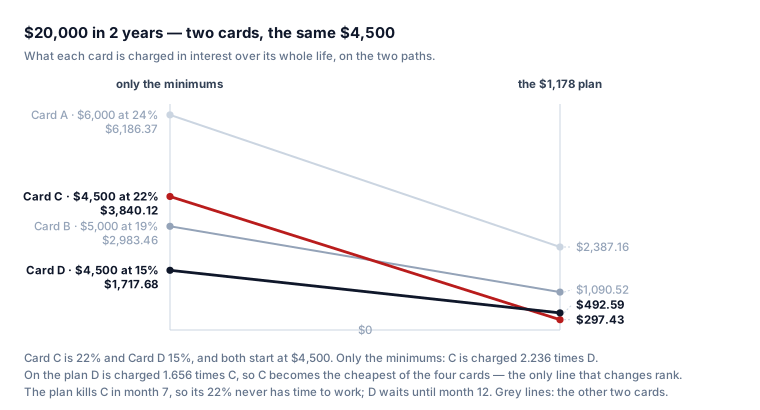
Card C and Card D both start at $4,500. Card C is the 22% one with a $110 minimum; Card D is the 15% one with a $115 minimum. Same balance, different rate — and the two paths charge them in opposite orders.
Left to the minimums, Card C is charged $3,840.12 and runs seventy-five months, while Card D is charged $1,717.68 and runs fifty-five. The higher rate is the expensive card by 2.236 times. Both differences push the same way: Card D's minimum is the larger slice of its own balance — 2.556% against 2.444% — so it pays itself down faster as well as more cheaply, and its rate is seven points lower. Six years is long enough for all of that to compound.
On the $1,178 plan the pair flips. Card C is the first target and dies in month 7, charged $297.43. Card D is not reached until month 8 and dies in month 12, charged $492.59. The 15% card is now the expensive one, at 1.656 times the 22% card.
What decides it is when the plan arrives. The plan holds the same $678 of new money above the minimums every month, so the card it is aimed at is paid $678 plus its own minimum: Card C gets $788 a month and Card D $793. Card C gets there first — the two cards start level, and the snowball's tie goes to the higher rate — and it is gone before its 22% has time to work: six payments of $788 plus $69.43 in month 7 is $4,797.43 against a $4,500 balance, so the whole seven months cost $297.43.
Card D waits. In months 1 to 6 it gets only its $115 minimum — $690 of payments that retire $363.70 of the balance, because $326.30 of that $690 is interest. Then the plan reaches it in month 8 at $793 a month and finishes it in month 12. Both cards are cheap on the plan; the difference between them is only which one the plan reached first.
Put the two paths side by side and the size of it is plain. The same $4,500 costs $3,840.12 if the 22% card is left alone and $297.43 if it is killed in seven months — 12.9 times less. On the 15% card the same pair of numbers is $1,717.68 against $492.59, 3.49 times less. A rate is only expensive while it has time to run.
| The card | Its rate | Minimums only | On the plan | Cleared |
|---|---|---|---|---|
| Card A — $6,000 | 24% | $6,186.37 | $2,387.16 | month 24 |
| Card B — $5,000 | 19% | $2,983.46 | $1,090.52 | month 18 |
| Card C — $4,500 | 22% | $3,840.12 | $297.43 | month 7 |
| Card D — $4,500 | 15% | $1,717.68 | $492.59 | month 12 |
Read the two $4,500 rows together and the flip is the table. On the minimums Card C is the second-most expensive of the four cards; on the plan it is the cheapest — and it is the only card in the portfolio whose rank changes. Card A and Card B simply get cheaper, in the same order.
What the two years cost
The twenty-four months cost $4,267.71 of interest, and the total that leaves your account is $24,267.71. The interest is 21.34% of the balance you started with and 17.59% of everything you send. The whole two years of interest is 8.535 of the $500 minimum payments, and the monthly charge falls from $337.92 in month 1 to $16.15 in month 24 — 20.92 times less. By the last payment, 98.04% of the $823.71 reaches principal and only 1.96% is interest, against 28.69% in month 1.
Avalanche is cheaper here, but it is not faster. Run at the same $1,178 a month it is charged $3,737.52 — $530.19 less, so the snowball bill is 1.142 times the avalanche bill — and it also lands in twenty-four months. Avalanche can clear the balance at its own lower threshold of $1,149, and at that smaller payment it is charged $3,826.56; the $3,737.52 above is the equal-payment figure, so the two numbers differ by the payment they are measured at, not by the method. Whether the two orders ever pull apart by a month is a separate question from what they cost, and it is the one we answered by running twelve portfolios through the calculator, snowball against avalanche: three of the twelve landed in the same month, and the four-card portfolio on this page is a fourth case of it.
The payments step down three times as cards close: $1,178 in months 1 to 7, $1,068 in months 8 to 12, $953 in months 13 to 18, $828 in months 19 to 23, and $823.71 in month 24. Each drop is exactly the minimum of the card that just cleared — $110 for Card C, $115 for Card D, $125 for Card B — and the fourth drop, Card A's $150, never arrives: the plan ends at $823.71 instead of $828. The balance path is $19,159.92, $18,304.84, $17,434.50, $16,548.62, $15,646.92, $14,729.12, $13,794.92, $12,958.23, $12,110.65, $11,252.04, $10,382.25, $9,501.14, $8,721.90, $7,930.16, $7,125.72, $6,308.39, $5,477.94, $4,634.17, $3,898.86, $3,148.83, $2,383.81, $1,603.49, $807.56 and zero.
The deadline itself is exact. $1,178 a month lands the payoff in twenty-four months; $1,177 adds a twenty-fifth and takes the interest to $4,273.63. Avalanche's own deadline sits lower: $1,149 finishes in twenty-four months, and $1,148 pushes it to twenty-five and $3,831.81. The first twelve months send $13,586.00 and the last twelve $10,681.71 — 21.38% less — and they retire $10,498.86 against $9,501.14. Twenty-four flat payments of $1,178 would come to $28,272; the plan sends $24,267.71, so $4,004.29 of those flat payments never happens.
Where the $678 comes from
This is the part that decides whether the plan happens, so it is worth stating plainly: you need $678 a month above the $500 you already pay — 1.356 times the minimums — and over the twenty-four months the new money alone is $16,272, which is 81.36% of the balance. The plan pays 2.356 times the minimums and finishes the job in 24 months instead of 82 — 3.417 times faster.
Two comparisons make the size of the ask concrete. The plan's $24,267.71 is 69.88% of the $34,727.64 the minimums-only path costs, so you spend about two thirds of the money and save $10,459.93. And month 1 of the minimums is charged the same $337.92 the plan is, but of that $500 only $162.08 reaches principal — 32.42%, against 71.31% for the plan's first payment. Leave the minimums running for the same twenty-four months and you would send $12,000, of which $7,309.39 is interest — 60.91% of it — and you would still owe $15,309.39, 76.55% of the balance.
Stretching the same $20,000 across different deadlines is a separate trade, and it is worth naming. The lowest payment that clears it in six months is $3,688 a month, for $1,216.88 of interest; in twelve months it is $2,026 a month, for $2,248.59; in twenty-four months it is $1,178 a month, for $4,267.71; in thirty-six months it is $900 a month, for $6,219.69. Going from one year to two cuts the payment by $848 a month and adds $2,019.12 of interest, which is 89.8% of the twelve-month bill. You are buying cash flow, and you are paying for it in interest.
Card by card, the plan is charged $2,387.16 on Card A, $1,090.52 on Card B, $297.43 on Card C and $492.59 on Card D. Card A is 30.00% of the balance but 55.94% of the plan's interest bill, which is why paying it first is the whole of the avalanche advantage. On the minimums-only path the same four cards are charged $6,186.37 (Card A, cleared in month 82), $2,983.46 (Card B, month 64), $3,840.12 (Card C, month 75) and $1,717.68 (Card D, month 55) — Card A alone runs the last seven months.
Reproduce these numbers
Every figure on this page comes from this site's public API. Post the four balances, their rates, their minimums and extra: 678 to /api/payoff and you get the same months, the same $4,267.71 and the same per-card breakdown — including the remaining on each month of the timeline, once with extra: 678 and once with extra: 0. Two things that trip people up: APR goes in as a percentage (24, not 0.24), and extra is the amount above your total minimums, not your total payment — $678 here, which is what turns the $500 in minimums into $1,178 a month. Or just open the calculator and type your balances in — same engine, no payload.
If your target is a different size or a different deadline, the same analysis is in the $20K in 1 year, $20K in 6 months, $25K in 2 years, $25K in 1 year, $30K in 2 years, $30K in 1 year, $30K in 6 months, $40K in 2 years, $40K in 1 year, $40K in 6 months, $80K in 2 years, $80K in 12 months, $80K in 6 months, $70K in 2 years, $70K in 12 months, $70K in 6 months, $60K in 2 years, $60K in 12 months, $60K in 6 months, $50K in 2 years, $50K in 12 months, $50K in 6 months, $15K in 1 year, $15K in 6 months, $10K, $10K in 6 months, $5K in 1 year, $5K in 6 months and $100K case studies, plus a 36-second walkthrough of the $25K case on YouTube. Shorter answers to the most common payoff questions live in the payoff questions hub.
Frequently asked
How much do I have to pay a month to clear $20,000 in two years?
On the four-card example here, $1,178 a month clears the $20,000 in twenty-four months on the snowball method, which is $678 above the $500 in minimums. Avalanche needs less — $1,149 — because it goes at the 24% card first.
How much interest does $20,000 cost over two years?
The snowball plan is charged $4,267.71 and the total that leaves your account is $24,267.71 — the $20,000 balance plus that interest. The interest is 21.34% of the balance you started with and 17.59% of everything you send, and it is 8.535 of the $500 minimum payments. Run at the same $1,178 a month, avalanche is charged $3,737.52, which is $530.19 less — 1.142 times the avalanche bill — and it lands in the same twenty-four months.
Two cards, the same $4,500 — why does the 15% one cost more?
Because of when the plan reaches it. Card C is 22% and Card D is 15%, and both start at $4,500. The plan holds the same $678 above the minimums every month, so the card it is aimed at is paid $678 plus its own minimum — Card C $788 a month, Card D $793. The two cards start level and the snowball's tie goes to the higher rate, so Card C is killed first, in month 7, and charged $297.43 before its 22% has time to work. Card D waits on its $115 minimum until month 8 and dies in month 12, charged $492.59 — 1.656 times the 22% card. On the minimums alone the order is reversed: Card C is charged $3,840.12 against Card D's $1,717.68, 2.236 times as much.
Does it matter which card I pay off first on a two-year plan?
It is worth $530.19 at the same $1,178 a month, and here it is not worth any time: both methods land in twenty-four months. Snowball clears Card C in month 7, Card D in month 12, Card B in month 18 and Card A in month 24; avalanche clears Card A in month 8, Card C in month 14, Card B in month 20 and Card D in month 24. Card A is 30.00% of the balance but 55.94% of the snowball interest bill — $2,387.16 of the $4,267.71.
What if I only pay the minimums on $20,000?
The $500 in minimums clears the balance in 82 months and costs $14,727.64 in interest, a total bill of $34,727.64. The twenty-four-month plan is charged $4,267.71, a saving of $10,459.93. The plan also finishes 3.417 times faster: 24 months against 82. Month 1 of the minimums is charged the same $337.92 the plan is, but only $162.08 of that $500 reaches principal, against $840.08 of the plan's first payment. Avalanche on the minimums takes 80 months and $14,702.41 — just $25.23 less.
How long does it take to pay off $20,000 in 2 years?
Two years, by definition — but only if you send $1,178 a month, which is 2.356 times the $500 in minimums. The deadline is exact: $1,178 lands the payoff in twenty-four months and $1,177 adds a twenty-fifth. Avalanche's own deadline sits lower, at $1,149, and $1,148 pushes it to twenty-five months. The minimums alone take 82 months on the same portfolio and cost $14,727.64 in interest.
What is the blended interest rate on this portfolio?
20.275% a year, weighted by balance: $6,000 at 24%, $5,000 at 19%, $4,500 at 22% and $4,500 at 15% work out to $4,055.00 of annual interest on $20,000. One twelfth of that is 1.68958%, which is $337.92 on the opening balance — $120.00 on Card A, $79.17 on Card B, $82.50 on Card C and $56.25 on Card D. By month 24, under the plan, the monthly interest is down to $16.15 — 20.92 times less than month 1.
What happens in the last month of the plan?
Month 24 is the only payment that is not a round step. The plan's twenty-three full payments are $1,178, $1,068, $953 and $828, and the last one is $823.71, because the balance runs out partway through the month — Card A's $150 minimum would have taken the payment to $828, and $4.29 of that is never needed. Of that final $823.71, $807.56 reaches principal and $16.15 is interest, which is 1.96% of the payment against 28.69% in month 1.