Numbers from this site's public API. The 6.39% is the published 2025-26 rate for undergraduate Direct Loans first disbursed between 1 July 2025 and 30 June 2026; the 24% is an illustrative card rate, the same range the case studies on this site use. Open the calculator with your own balances and rates and the same numbers come out in real time.
The two sides of the same $20,000
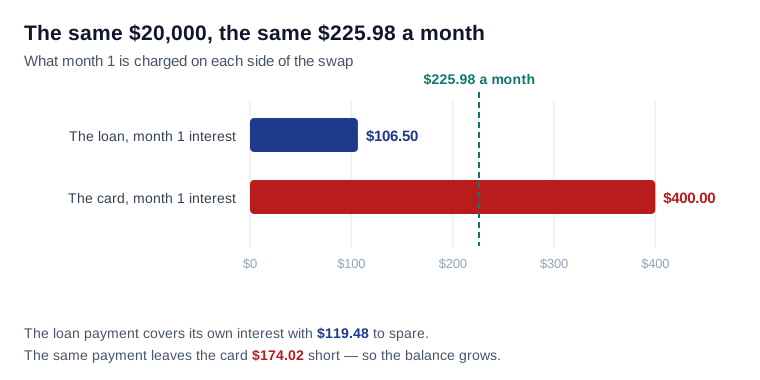
The loan side is a real schedule, not a scenario: the ten-year Standard Plan divides a federal Direct Loan balance into 120 fixed payments. On $20,000 at 6.39% that payment is $225.98 a month, and the loan is gone in 120 months having cost $7,117.30 of interest. In month 1 the loan is charged $106.50, so $119.48 of the first payment reaches the balance — 52.87% of it. The loan has an end date written into it.
The card side has no such date. A card balance is charged whatever its rate says, and the minimum is a percentage of the balance rather than a schedule that finishes. On the same $20,000 at 24% the first month is charged $400.00 of interest — 3.756 times the loan's $106.50 — and if you send the card the same $225.98 the loan takes, the payment is $174.02 short of the interest alone. The balance grows. That is the whole swap in one line: the loan's payment clears principal from month 1, and the same payment on the card does not even hold the balance still.
| The loan, 6.39% | The card, 24% | |
|---|---|---|
| Month 1 interest | $106.50 | $400.00 |
| What $225.98 does | clears it in 120 months | $174.02 short of the interest |
| Payment that clears it | $225.98 | $500.00 |
| Months | 120 | 82 |
| Interest | $7,117.30 | $20,637.97 |
| Total sent | $27,117.30 | $40,637.97 |
What the swap costs
Reading the last two rows together is the answer. The loan is finished for $27,117.30; the card costs $40,637.97 — $13,520.67 more, and its interest bill alone ($20,637.97) is 2.900 times the loan's $7,117.30. The card does finish sooner on the calendar, 82 months against 120, because $500 is a much bigger payment than $225.98. That is the trade in full: a shorter schedule bought with a much larger payment, and nearly three times the interest.
Month 1 shows where the money goes. Of the card's $500 payment, $400.00 is interest — 80.00% of it — and only $100.00 touches the balance. Of the loan's $225.98, $106.50 is interest, 47.13%. Same balance, same month, and the card is sending four times as much of the payment to the lender's side of the ledger.
What it takes to clear the card
Because the interest is $400.00 a month at the start, anything at or below that only holds the balance still. $400.00 a month never repays a cent — the API caps the run at 600 months and charges $240,000.00 to get nowhere. Above the interest the balance does fall, but slowly at first: $450 a month takes 111 months and $29,930.48 of interest, $500 takes 82 months and $20,637.97, and $600 takes 56 months and $13,288.35. Every one of those interest bills is larger than the entire $27,117.30 the loan costs, principal included.
The better version of the same idea
If the goal is to be done sooner, the loan is the cheaper place to put extra money, and the reason is the rate. Adding $125 a month to the loan takes the payment to $350.98 and clears it in 69 months for $3,896.88 of interest — $3,220.42 less than the standard schedule. Set that against the card: $149.02 a month less than the card's $500, thirteen months sooner, and $16,741.09 less interest. The extra money is doing the same work in both cases; on the 6.39% side it is simply fighting a much smaller interest charge.
The published federal rates
For Direct Loans first disbursed between 1 July 2025 and 30 June 2026 the published rates are 6.39% for undergraduate loans, 7.94% for graduate unsubsidized loans and 8.94% for PLUS loans. On $20,000 the ten-year Standard Plan's level payment is $225.98 a month at 6.39%, $242.02 at 7.94% and $252.70 at 8.94%. The 6.39% payment clears the loan in 120 months for $7,117.30 of interest; at the two higher rates the cent-rounded payment leaves 29 cents and 50 cents outstanding after the 120th month, so the API runs a 121st month and the interest comes to $9,042.69 and $10,324.50. All three are below the illustrative 24% card rate used above — the highest of them, 8.94%, is still under 40% of it.
What this page does not answer
Deliberately: whether your servicer accepts a card payment, whether a third-party payment service is permitted, how any of this would be treated for tax, what it does to your credit score, and whether you would still qualify for consolidation or an income-driven plan afterwards. Those are account rules and legal questions rather than arithmetic, and this site does not answer them. Ask your servicer and get the answer in writing before you move anything — the numbers on this page only tell you what the rates do, not what you are allowed to do.
Reproduce these numbers
Every figure here comes from this site's public API. Post the balance, the rate and the payment to /api/payoff and you get the same months and the same interest back. The loan is {"balance": 20000, "apr": 6.39, "minPayment": 225.98} with extra: 0, which returns 120 months and $7,117.30. The card is {"balance": 20000, "apr": 24, "minPayment": 500} with extra: 0, which returns 82 months and $20,637.97; change minPayment to 450, 600 or 400 and the other rows come out. Two things to know about the API's conventions: APR goes in as a percentage (24, not 0.24), and minPayment is held fixed for the whole run rather than recalculated as a percentage of the falling balance. That is the convention every page on this site uses, and it is the one thing that makes the card rows above a floor rather than a forecast — a real card that recomputes its minimum at 2.5% of a shrinking balance would take longer than 82 months and cost more than $20,637.97, not less. Or just open the calculator and type your own numbers in.
Frequently asked
Can you pay off a student loan with a credit card?
Whether your servicer will take a card payment is a question for your servicer, and this page deliberately does not answer it — we do not give legal, tax or account-rules advice. What we can do is price the arithmetic, and on the arithmetic the answer is usually no. Moving a 6.39% student loan onto a card at 24% takes the rate up 3.756 times on the opening balance: the loan is charged $106.50 of interest in month 1, the card $400.00.
What does the swap cost on $20,000?
On the ten-year Standard Plan the $20,000 loan at 6.39% costs $7,117.30 of interest and $27,117.30 in total. The same $20,000 on a card at 24%, paying $500 a month, costs $20,637.97 of interest and $40,637.97 in total — $13,520.67 more, or 2.900 times the loan's interest bill.
What if I keep paying the loan's own payment on the card?
Then the card never clears. $225.98 a month does not cover the card's first month of interest, which is $400.00 — the payment is $174.02 short and the balance grows instead of shrinking. $400.00 a month is the break-even point where the balance stands still and nothing is ever repaid; the API caps the run at 600 months and charges $240,000.00 to get nowhere.
How much would I have to pay to clear the card?
More than the interest. At $450 a month the $20,000 card clears in 111 months for $29,930.48 of interest; at $500 a month it clears in 82 months for $20,637.97; at $600 a month it clears in 56 months for $13,288.35. Every one of those totals is larger than the $27,117.30 the loan costs in full.
What are the current federal student loan rates?
For Direct Loans first disbursed between 1 July 2025 and 30 June 2026 the published rates are 6.39% for undergraduate loans, 7.94% for graduate unsubsidized loans and 8.94% for PLUS loans. On $20,000 the ten-year Standard Plan's level payment is $225.98 a month at 6.39%, $242.02 at 7.94% and $252.70 at 8.94%. The 6.39% payment clears the loan in 120 months for $7,117.30 of interest; at the two higher rates the cent-rounded payment leaves 29 cents and 50 cents outstanding after the 120th month, so the API runs a 121st month and the interest comes to $9,042.69 and $10,324.50.
Is paying the loan faster a better move than moving it to a card?
On this example, yes. Adding $125 a month to the loan takes the payment to $350.98 and clears it in 69 months for $3,896.88 of interest — $3,220.42 less than the loan's own standard schedule. That is $149.02 a month less than the $500 the card needs, it finishes thirteen months sooner, and it costs $16,741.09 less interest.
What is the ten-year Standard Plan?
It is the default federal repayment schedule: the balance is divided into fixed monthly payments over 120 months. On $20,000 at 6.39% the fixed payment is $225.98 a month, which is why the loan has an end date at all. A credit card balance has no such date — the minimum is a percentage of the balance, so the schedule is set by how much you send, not by the loan.
What does this page not answer?
It does not answer whether your servicer accepts a card payment, whether a third-party service is allowed, how the swap would be treated for tax, what it does to your credit score, or whether you would still qualify for consolidation or an income-driven plan. Those are account rules and legal questions, not arithmetic, and this site does not answer them. Ask your servicer, and get the answer in writing before you move anything.