Numbers from this site's public payoff engine. The $10,000 at 24% is an illustrative single card; the 15% case is an illustrative lower-rate card. Both use the same engine every page on this site uses. Open the calculator with your own balances and rates and the same numbers come out in real time.
On the minimum, the balance barely moves
A credit card at 24% charges $200 of interest on a $10,000 balance in the first month alone. So of the $250 minimum, only $50 touches the balance — 20% of the payment. That is the whole trap: the minimum is sized to cover the interest and a thin slice of principal, so the balance falls slowly and the debt lingers. Run the $250 minimum out and the card clears in 82 months, having charged $10,318.98 of interest — more than the $10,000 you originally owed. The minimum is the most expensive way to carry a balance, every time.
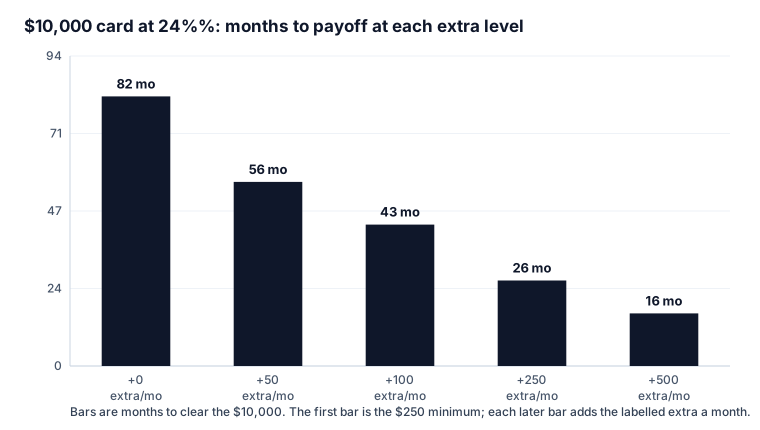
The fix is not heroic. Because month 1's interest is fixed at $200 on the opening balance, sending $300 instead of $250 puts a whole extra $50 on the balance from the first month, and that extra compounds against the interest for the rest of the run. The table below shows what each extra level buys.
| Extra a month | Payment | Months | Interest | Saved vs minimum | Months saved |
|---|---|---|---|---|---|
| +$0 (minimum) | $250 | 82 | $10,318.98 | $0.00 | 0 |
| +$50 | $300 | 56 | $6,644.17 | $3,674.81 | 26 |
| +$100 | $350 | 43 | $4,976.08 | $5,342.90 | 39 |
| +$250 | $500 | 26 | $2,898.73 | $7,420.25 | 56 |
| +$500 | $750 | 16 | $1,748.39 | $8,570.59 | 66 |
Why the minimum is a trap
The minimum is not designed to clear the debt quickly — it is designed to keep the account open and earning interest. On a $10,000, 24% card the monthly interest is $200, so a $250 minimum leaves just $50 for principal. Lower the rate and the same minimum leaves more for principal, but the structure is identical: most of the payment services the lender's charge, and the balance crawls down. The only way out is to send more than the interest — and the earlier you start, the less interest you finance. The split also moves on its own: on a $5,000 card at 24% with a $125 minimum, $25 of the first payment is principal and the payment does not become majority principal until month 48 — same structure, smaller numbers.
The first $50 matters most
The first $50 is the biggest jump: it takes 26 months off the payoff and saves $3,674.81 of interest. Each further step saves fewer months — $100 saves 39, $250 saves 56, $500 saves 66 — because once the balance starts falling, the interest it is charged falls with it, so later dollars have less interest left to erase. The point is not to find a magic number. The point is that the gap between the minimum and a modest extra is enormous, and even $50 a month changes the outcome. You do not need to double the payment to matter; you need to get above the interest line. The same curve on a $5,000 card shows how fast the steps flatten: $25 buys 26 months, the next $25 buys 13.
A lower-rate card is less brutal, not safe
The minimum is softer on a cheaper card, but it is still a trap. Put the same $10,000 at 15% with a $200 minimum and the minimum alone takes 79 months and costs $5,791.20 of interest — against 82 months and $10,318.98 at 24%. And the same $100 extra saves $2,774.16 at 15% but $5,342.90 at 24% — 1.93 times as much — because the higher rate is charging more to begin with. A lower rate delays the pain; it does not remove it. This is why the extra should always go to your highest-rate debt first.
What to do instead
Pay every minimum, then throw whatever extra you can at your highest-rate debt until it is gone, and only then move to the next. That is the avalanche method, and it is the cheapest way to clear a portfolio. Even $50 a month above the minimum on the 24% card saves $3,674.81 and 26 months; double the minimum and the saving passes $7,400. The minimum keeps the account open; anything above it is what actually closes it.
Reproduce these numbers
Every figure here comes from this site's public engine. Post a single balance, its rate and its minimum to /api/payoff and you get the same months and the same interest back. The card is {"balance": 10000, "apr": 24, "minPayment": 250} — with extra: 0 it returns 82 months and $10,318.98, and with extra: 50 it returns 56 months and $6,644.17. The lower-rate card is {"balance": 10000, "apr": 15, "minPayment": 200}, which returns 79 months and $5,791.20 at extra: 0 and 44 months and $3,017.04 at extra: 100. Two conventions to know: APR goes in as a percentage (24, not 0.24), and minPayment is held fixed for the whole run rather than recalculated as a percentage of the falling balance — the same convention every page on this site uses. A real card that recomputes its minimum at 2-3% of a shrinking balance would take longer and cost more than the $10,318.98 shown, not less. Or just open the calculator and type your own numbers in.
Frequently asked
What happens if you only pay the minimum on a credit card?
The balance barely moves for years. On a $10,000 card at 24%, the $250 minimum takes 82 months — nearly seven years — and costs $10,318.98 of interest, which is more than the $10,000 you borrowed. Of the first $250 payment, $200 is interest and only $50 touches the balance. The minimum is sized to cover the interest plus a sliver, so the debt lingers.
How long does it take to pay off a credit card on minimum payments?
On the $10,000, 24% example it is 82 months at the $250 minimum. The exact time depends on the balance, the rate and the issuer's minimum formula, but the shape is always the same: because most of the minimum is interest, the payoff stretches into many years. A lower-rate card is less extreme but still long — $10,000 at 15% on a $200 minimum takes 79 months.
Why does the minimum payment barely reduce the balance?
A card at 24% charges $200 of interest on a $10,000 balance in the first month. So of a $250 minimum, only $50 is left for the balance — 20% of the payment. The minimum is built to cover the interest and a small slice of principal, which is exactly why the balance falls so slowly and the loan feels stuck.
How much extra should I pay to make a difference?
Even a little helps, and the first dollars help most. On the 24% card, $50 extra (a $300 payment) cuts the payoff from 82 months to 56 and saves $3,674.81 of interest; $100 extra ($350) reaches 43 months and saves $5,342.90. You do not need to double the payment to change the outcome — you need to get above the interest line, and the sooner the better.
What if I pay double the minimum?
Doubling the $250 minimum to $500 clears the $10,000 card in 26 months for $2,898.73 of interest — a saving of $7,420.25 against the minimum. Going to $750 (an extra $500) finishes in 16 months for $1,748.39. Double the minimum captures most of the available saving; beyond that you are trading small interest for convenience.
Does a lower-rate card take less time on the minimum?
Yes, but it is less safe than it looks. $10,000 at 15% on a $200 minimum takes 79 months and costs $5,791.20 of interest, against 82 months and $10,318.98 at 24%. And the same $100 extra saves $2,774.16 at 15% but $5,342.90 at 24% — 1.93 times more — because the higher rate is charging more to begin with. A lower rate softens the minimum; it does not remove the trap.
Does this work the same for a loan as a credit card?
The arithmetic is the same, but the minimum behaves differently. A loan's minimum is usually a fixed amortising payment, so it does finish on schedule; a card's minimum is a percentage of the balance, which keeps the loan open far longer. Either way, paying above the minimum shortens the loan and cuts interest, and aiming the extra at your highest-rate debt saves the most.