Two kinds of numbers here, kept separate on purpose. The utilization figures (83% → 37%) are plain arithmetic — the same concrete math this site uses everywhere. The FICO factor weights and the inquiry point ranges are the published scoring model (FICO's own disclosures), not output of this site's payoff engine, and they are stated as published figures. Open the calculator for the debt side; the utilization math below is just balance ÷ limit.
The score impact is mostly about utilization
A credit score is built from five weighted factors. The one a balance transfer moves the most is amounts owed — your credit utilization, or balance divided by limit — because that is the factor you can change overnight by shuffling balances between cards. Here is how a 0% transfer pushes each factor, using the $10,000 / $12,000-limit example.
| Factor | Weight | What a 0% transfer does | Net |
|---|---|---|---|
| Payment history | 35% | Unchanged — as long as you keep paying on time | neutral |
| Amounts owed (utilization) | 30% | $10,000 on $12,000 (83%) → keep old open, $27,000 limit → 37% | strong + |
| Length of history | 15% | New card slightly shortens average age | small − (temp) |
| New credit | 10% | One hard inquiry + one new account | small − (temp) |
| Credit mix | 10% | One more revolving card | neutral / slight + |
The concrete scenario: $10,000 on a $12,000 limit
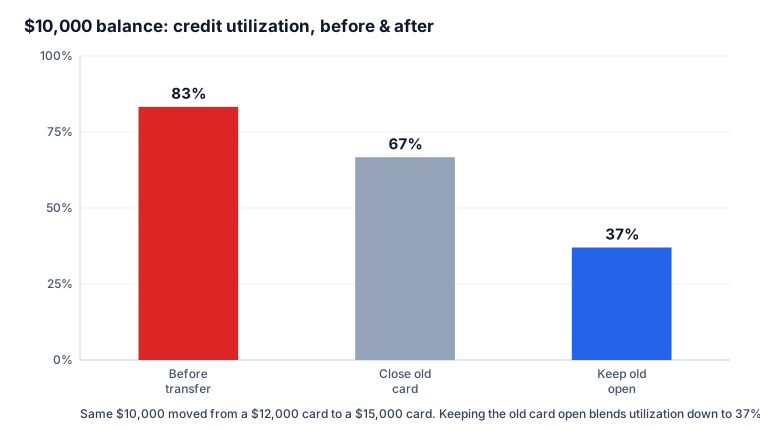
Start at 83% utilization — the balance is $10,000 and the limit is $12,000. That alone is enough to drag a score down hard; utilization in the high 70s and 80s is the territory where people get denied. Now open a $15,000-limit card and move the balance onto it:
- Close the old card: the $10,000 sits on the new card alone — $10,000 ÷ $15,000 = 67%. Better than 83%, but the closed limit is gone.
- Keep the old card open at $0: total limit is now $12,000 + $15,000 = $27,000, same $10,000 balance → 37% blended. This is the move that actually helps.
The only real hit is the hard inquiry
Applying for the new card is a hard inquiry, and FICO's own guidance is that most people lose fewer than 5 points from a single inquiry — some lose nothing. The new account also nudges the average age of your accounts down, which is another few points, but both effects are temporary. The inquiry stops counting within about 12 months, and the age effect fades as the account matures. One application is minor; the danger is applying for several cards within a few months, because the cluster of inquiries signals that you are hunting for credit and can drop the score more.
Keep the old card open
This is the single most-missed step. If you close the old card after moving the balance, you throw away its limit and land at 67% instead of 37%, and you also shorten your credit history. Keep it open, pay it to $0, and use it once a year for a small charge so the issuer does not close it for inactivity. You get the lower blended utilization without giving up the older account — the best of both.
How long the impact lasts
The hard inquiry is the shortest-lived piece: it affects the score for about 12 months and stays on the report for two. The new-account age effect recovers over one to two years. The utilization improvement, by contrast, is immediate and persists as long as your balances stay low. So the real shape of the event is a small, brief dip followed by a lasting improvement — for most people who keep the old card open and pay on time, the score is higher a year after the transfer than it was before.
Reproduce the utilization math
The part of this page you can check yourself is pure arithmetic, not a model. Utilization = balance ÷ limit:
- Before:
10000 / 12000 = 0.833 → 83% - Close old:
10000 / 15000 = 0.667 → 67% - Keep open:
10000 / (12000 + 15000) = 10000 / 27000 = 0.370 → 37%
The FICO factor weights (payment history 35%, amounts owed 30%, length 15%, new credit 10%, credit mix 10%) and the inquiry point ranges are the published scoring model from FICO's disclosures — they are real, widely cited figures, but they are not computed by this site's engine, and individual results vary with your whole file. The debt side of every other page on this site comes from this site's public payoff engine; for the score side, the utilization numbers above are the only part this site computes.
Frequently asked
Does a 0% balance transfer hurt your credit score?
Usually it helps, not hurts. On a $10,000 balance and a $12,000 limit, your card sits at 83% utilization — the second-biggest score factor after paying late. Move that balance to a new $15,000-limit card and keep the old one open, and your total utilization falls to 37%, which is strongly positive for your score. The only real cost is one hard inquiry (most people lose fewer than 5 points, fully recovered within about a year) and a small, temporary new-account dip. A 0% balance transfer hurts your score only if you close old cards, miss payments, or apply for several cards at once.
How many points does a balance transfer drop your score?
One balance transfer card application is a single hard inquiry, and FICO says most people lose fewer than 5 points from it; the new-account and average-age effect is another few points, both temporary. So the typical hit is under 10 points total, and it fades — the inquiry stops counting within about 12 months and the age effect recovers as the account matures. Several applications in a short window stack up and can drop the score more, because it looks like you are hunting for credit.
Why would a balance transfer help your credit score?
Because of the amounts-owed factor, which is 30% of a FICO score. Utilization is your balance divided by your limit: $10,000 on a $12,000 limit is 83%, which is brutal. Move it to a $15,000-limit card and keep the old card open ($0 balance) and your total limit becomes $27,000, so the same $10,000 balance is only 37% — a big drop in the factor that moves your score most after payment history. Lower utilization almost always means a higher score.
Does closing the old card hurt your score?
Yes, if you close it you lose that card's limit from your total. Keeping it open and paying it to $0 gives the 37% blended utilization above; closing it leaves the $10,000 sitting on the new $15,000 card alone, which is 67% — better than 83% but not nearly as good as 37%. Closing also shortens your average account age, which is part of the 15% length-of-history factor. Keep the old card open and use it once a year so it stays active.
How long does the credit score impact last?
The hard inquiry is the shortest-lived: it stops affecting the score within about 12 months. The new-account and average-age effect fades over one to two years as the account ages. The utilization improvement, by contrast, is immediate and stays as long as your balances stay low — so the net effect is a temporary small dip followed by a lasting improvement for most people who keep the old card open and pay on time.
Will applying for a balance transfer card show as a hard inquiry?
Yes. The new card application is a hard pull on your credit, and it appears on your report for two years even though it only affects the score for about one. One inquiry is minor; the problem is applying for several cards close together, because each adds an inquiry and the cluster signals elevated risk. Space applications out and only open the one card you actually need for the transfer.
Does a balance transfer affect your score if you pay on time?
If you pay on time and keep the old card open, the score impact is positive to neutral: utilization drops sharply and payment history — the 35% factor — stays clean. The risks that actually hurt (a utilization spike from closing cards, a missed payment, or a pile of inquiries) only bite if you mishandle the transfer. Pay on time, keep the old card open, and apply for just the one card, and a 0% transfer is net good for your score within a year.