Numbers from this site's public payoff engine. The $10,000 at a $250 minimum is an illustrative single card; the sweep holds the balance and payment fixed and moves only the rate, so the months and interest you see are the rate's doing alone. Open the calculator with your own balance and rate and the same numbers come out in real time.
The rate decides the timeline, not the balance
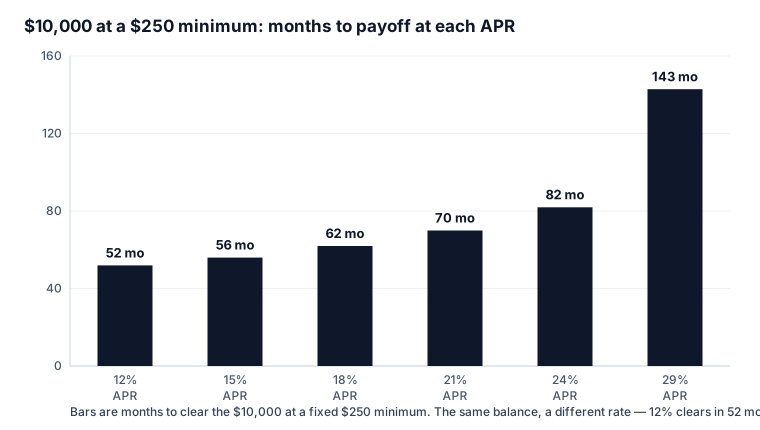
People blame the size of the balance for a long payoff, but the balance only scales the loan — the rate sets the shape. Hold a $10,000 balance and a $250 minimum fixed and move only the APR, and the payoff swings from 52 months at 12% to 143 months at 29%. Same debt, same payment, 91 extra months and $22,774.32 more interest purely from the rate. The table below isolates the rate so you can see it work.
| APR | Month-1 interest | Months | Total interest | Total bill | % of 1st payment to principal |
|---|---|---|---|---|---|
| 12% | $100.00 | 52 | $2,834.67 | $12,834.67 | 60.0% |
| 15% | $125.00 | 56 | $3,949.66 | $13,949.66 | 50.0% |
| 18% | $150.00 | 62 | $5,386.23 | $15,386.23 | 40.0% |
| 21% | $175.00 | 70 | $7,350.19 | $17,350.19 | 30.0% |
| 24% | $200.00 | 82 | $10,318.98 | $20,318.98 | 20.0% |
| 29% | $241.67 | 143 | $25,608.99 | $35,608.99 | 3.3% |
Why a higher APR is a different animal
The minimum payment always covers the interest first, and a higher rate eats more of it. At 12% on $10,000 the first month's interest is $100, so $150 of a $250 minimum reaches the balance — 60% of the payment. At 24% the first month's interest is $200, leaving only $50 — 20%. At 29% it is $241.67, leaving just $8.33, or 3.3% of the payment. The higher the rate, the smaller the slice of your payment that is actually paying down the debt, so the balance falls slower and the loan runs longer. This is the mechanism behind every number in the table. Move the same arithmetic to a $5,000 card at 24% and the crossover — the first month principal beats interest — lands in month 48.
The 24% card: a worked example
At 24% on $10,000 with a $250 minimum, the card takes 82 months — nearly seven years — to clear and costs $10,318.98 of interest, more than you borrowed. Only $50 of the first $250 payment touches the balance. That is the same 24% card from the minimum-payment page, shown here so you can see it sit in the middle of the rate ladder — bad, but not the worst. Drop to 15% and it is 56 months and $3,949.66; climb to 29% and it is 143 months and $25,608.99. The difference between a manageable loan and a decade-long one is a handful of rate points.
Paying extra matters most at a high APR
Because the high rate is charging more to begin with, every dollar above the minimum erases more expensive interest. On the same $10,000 at a $250 minimum, sending an extra $100 a month saves $1,500.65 of interest at 15% (56 months down to 36) but $5,342.90 at 24% (82 months down to 43) — 3.56 times as much saving for the same extra dollars. This is why the extra should always go to your highest-rate debt first: that is where each dollar does the most work.
What to do about a high APR
Three moves shorten the run: pay above the minimum on the highest-rate debt (the avalanche method, the surest fix), move the balance to a lower rate, or both. A balance transfer to a 12% rate clears in 52 months where 24% takes 82 — but watch the transfer fee (usually 3-5%) and the intro clock, because a 0% promo expires and the rate then jumps. The transfer only helps if you pay it down before the promo ends. Whatever you do, the lever that matters is the rate; lowering it or out-running it with extra payments is what actually closes the loan.
Reproduce these numbers
Every figure here comes from this site's public engine. Post a single balance, its rate and its minimum to /api/payoff and you get the same months and the same interest back. The card is {"balance": 10000, "apr": 24, "minPayment": 250} — with extra: 0 it returns 82 months and $10,318.98, with apr: 12 it returns 52 months and $2,834.67, and with apr: 29 it returns 143 months and $25,608.99. Two conventions to know: APR goes in as a percentage (24, not 0.24), and minPayment is held fixed for the whole run rather than recalculated as a percentage of the falling balance — the same convention every page on this site uses. A real card that recomputes its minimum at 2-3% of a shrinking balance would take longer and cost more than the figures shown, not less. Or just open the calculator and type your own numbers in.
Frequently asked
How much does APR affect how long it takes to pay off a credit card?
Enormously, and far more than the balance does. On a $10,000 balance at a fixed $250 minimum, 12% APR clears the card in 52 months and costs $2,834.67 of interest, while 29% APR stretches to 143 months and $25,608.99 of interest — about 2.8 times the time and 9 times the interest for the same debt. The rate sets the timeline; the balance only scales it.
Why does a higher APR keep you in debt longer?
Because the minimum payment has to cover the interest first, and a higher rate eats more of it. At 12% on $10,000 the first month's interest is $100, so $150 of a $250 minimum reaches the balance — 60% of the payment. At 24% the first month's interest is $200, leaving only $50 — 20%. At 29% it is $241.67, leaving just $8.33, or 3.3% of the payment. The higher the rate, the less of your payment is actually paying down the debt, so the balance falls slower and the loan runs longer.
How much more interest do you pay at a higher APR?
On the $10,000, $250-minimum example, total interest runs from $2,834.67 at 12% up to $25,608.99 at 29% — a difference of $22,774.32 for the identical balance and payment. Each step up the rate ladder adds interest faster than the last, because the longer payoff means more months of compounding at the higher rate.
Is a 24% APR bad for a credit card?
By the numbers, yes. At 24% on a $10,000 balance with a $250 minimum, the card takes 82 months — nearly seven years — to clear and costs $10,318.98 of interest, more than the amount borrowed. Only $50 of the first $250 payment touches the balance. That is squarely in the high end of standard card pricing, and it behaves exactly like the trap it is.
Does paying extra matter more on a high-APR card?
Yes, and disproportionately. On the same $10,000 at a $250 minimum, sending an extra $100 a month saves $1,500.65 of interest at 15% (56 months down to 36) but $5,342.90 at 24% (82 months down to 43) — 3.56 times as much saving, for the same extra dollars. The high rate is charging more to begin with, so every dollar you send above the minimum erases more expensive interest. That is why the extra should always go to your highest-rate debt first.
What APR is considered high on a credit card?
Standard card APRs commonly run from the high teens into the high twenties; anything near the top of that range behaves like the 29% case above — 143 months and $25,608.99 of interest on a $10,000 balance. Penalty and some rewards cards sit at or above 29%. Once a rate is in the mid-twenties or higher, the minimum payment stops making real progress and the balance lingers for years, which is the definition of a high rate in practice.
Does a balance transfer help with a high APR?
It can, because moving the balance to a lower rate shortens the run on the exact terms shown here — a 12% rate clears in 52 months where 24% takes 82. The catch is the fee and the intro clock: a transfer usually costs 3-5% up front, and any 0% intro rate expires, after which the rate jumps. The transfer only helps if you pay it down before the promo ends; otherwise you have simply moved the high-rate problem. Paying above the minimum on the highest-rate debt remains the surest fix.