Numbers from this site's public payoff engine. The card is the same $10,000 at 24% with a $250 minimum used across the minimum-payment and APR pages, so the baseline (82 months, $10,318.98 interest) lines up exactly. A transfer holds the payment at $250 and assumes a 3% ($300) fee; during the promo interest is 0, then 24% resumes on the remaining balance. Open the calculator with your own balance and rate and the same numbers come out in real time.
A 0% transfer pauses the interest, it does not erase the debt
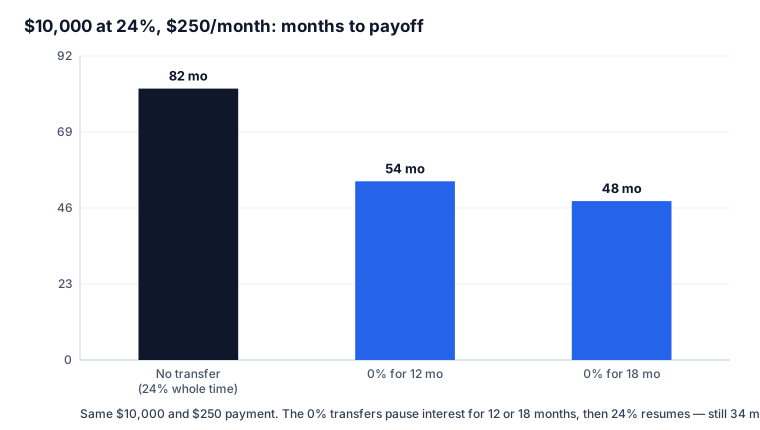
The saving is mechanical: for 12 or 18 months the balance earns nothing, so your payment goes straight to principal instead of feeding interest. Hold the monthly payment at $250 and compare the runs. The table below keeps the balance, the payment and the 3% fee fixed and moves only the length of the 0% window.
| Scenario | Months | Interest + fee | Total cost | You save | Months fewer |
|---|---|---|---|---|---|
| No transfer (24% whole time) | 82 | $10,318.98 | $20,318.98 | — | — |
| 0% APR for 12 months | 54 | $3,665.16 | $13,665.16 | $6,653.82 | 28 |
| 0% APR for 18 months | 48 | $2,120.47 | $12,120.47 | $8,198.51 | 34 |
How the 18-month transfer plays out
Start with $10,000 at 24% on a $250 payment. With no transfer the card runs 82 months and costs $10,318.98 of interest — more than you borrowed. Move it to an 18-month 0% card: for those 18 months the balance simply falls by $250 a month, reaching $5,500 with $0 interest charged. Then 24% resumes on that $5,500, which the same $250 payment clears in another 30 months for $1,820.47 of interest. Add the $300 transfer fee and the whole run is 48 months and $2,120.47 — a $8,198.51 saving over doing nothing. The 12-month version leaves $7,000 accruing interest after the promo, so it saves less: $6,653.82.
The fee is tiny next to the interest it avoids
A 3% transfer fee on $10,000 is $300. Against $10,318.98 of interest at 24%, that fee is noise — an 18-month transfer still nets an $8,198.51 saving. That $8,198.51 is already net of the $300 fee: you pay it once, up front, to move the balance onto the 0% card. Work the same transfer without the fee and it saves about $8,500; the gap between that and the $8,198.51 headline is exactly the cost of moving the balance, not a mistake anyone can pounce on. The fee only stops being worth it if you clear almost nothing during the promo, because then you have paid to move a balance you were not going to solve. As long as you pay the balance down while the rate is frozen, the fee pays for itself many times over.
What happens when the 0% promo ends
This is the part people miss. When the window closes, any balance left starts accruing the new card's standard rate — usually 24% to 29%. Many 0% offers are deferred interest: miss the deadline and the bank charges interest on the original amount from day one. So the promo is a clock, not a pardon. The transfer helps only if the balance is gone, or small enough to clear quickly, before the rate snaps back. Run new charges on the old card while the balance sits on the new one and you can end up worse than you started.
The biggest win: clear it before the promo ends
Every dollar paid during the promo is a dollar that never meets the 24% rate. To wipe out $10,000 inside an 18-month window you need about $556 a month (18 × $556 = $10,008, plus the $300 fee). That is more than double the $250 minimum, but it leaves you owing only the fee — a $10,010.98 saving and 64 fewer months than doing nothing. If $556 a month is not realistic, a longer promo or a partial payoff still beats paying 24% the whole time; the saving just shrinks in step with how little you clear before the rate returns.
Balance transfer vs just paying extra
They are the same lever seen two ways. Paying extra on the high-rate card attacks the interest directly; a 0% transfer freezes the interest so your payment attacks the principal instead. On this $10,000 at 24%, sending an extra $100 a month saves $5,342.90, while an 18-month 0% transfer at the same $250 base payment saves $8,198.51 — the transfer wins here because it zeroes the rate entirely rather than just trimming it. The best move stacks both: get the 0% rate and keep paying above the old minimum.
Reproduce these numbers
Every figure here comes from this site's public engine. Post a single balance, its rate and its minimum to /api/payoff and you get the same months and the same interest back. The baseline card is {"balance": 10000, "apr": 24, "minPayment": 250} — with extra: 0 it returns 82 months and $10,318.98. For a transfer, the promo is just zero interest for N months: the balance falls by the payment each month with no charge, then the remainder runs at 24% — the $5,500 remainder from the 18-month case returns 30 months and $1,820.47, which with the $300 fee gives the 48-month, $2,120.47 total. Two conventions to know: APR goes in as a percentage (24, not 0.24), and minPayment is held fixed for the whole run rather than recalculated as a percentage of the falling balance — the same convention every page on this site uses. Or just open the calculator and type your own numbers in.
Frequently asked
How much does a 0% balance transfer save you?
The interest saving is large and immediate. On a $10,000 balance at 24% with a $250 payment, doing nothing costs $10,318.98 of interest over 82 months. Move it to a 0% offer for 18 months (typical 3% fee, $300) and the same $250 payment clears it in 48 months for $2,120.47 all-in — a $8,198.51 saving. A 12-month 0% offer saves $6,653.82. If you can pay about $556 a month you clear the whole balance inside an 18-month promo and owe only the fee, saving $10,010.98. The transfer only pays off if you actually pay it down before the promo ends.
How does a 0% balance transfer work?
You open a new card that charges 0% interest for an introductory window — usually 12 to 21 months — and move your old balance onto it. You pay a one-time transfer fee, almost always 3% to 5% of the amount moved. During the promo the balance earns no interest, so every payment goes straight to principal. When the window closes, whatever is left starts accruing the new card's standard rate, which is usually high. The whole benefit depends on how much you pay down while the rate is frozen.
Is the 3% transfer fee worth paying?
On the $10,000 at 24% example, the 3% fee is $300 — and a 12-month 0% transfer still saves $6,653.82, an 18-month one saves $8,198.51. That $8,198.51 is net of the $300 fee — you pay it once, up front, to move the balance onto the 0% card. Without the fee the same transfer saves about $8,500, so the gap to the headline is just the cost of moving the balance, not a discrepancy anyone can pounce on. The fee is a rounding error next to the interest it avoids, because 24% on a five-figure balance is hundreds of dollars a month. The fee only stops being worth it if you expect to clear almost nothing during the promo, in which case you have simply paid to move a problem you were not going to solve.
What happens when the 0% promo ends?
Any balance still on the card starts accruing the new card's standard APR, which on most cards is 24% to 29%. Worse, many 0% offers are deferred interest: if you have not paid the balance off by the deadline, the bank charges interest on the original amount from day one. So the promo is a clock, not a pardon. The transfer helps only if the balance is gone — or small enough to clear fast — before the rate snaps back.
How much do I need to pay to clear it during the promo?
On a $10,000 transfer, clearing it inside an 18-month window means paying about $556 a month (18 times $556 is $10,008, covering the balance, plus the $300 fee). That is more than double the $250 minimum, but it leaves you owing only the fee — a $10,010.98 saving versus doing nothing. If $556 a month is not realistic, a longer promo or a partial payoff still beats paying 24% the whole time; the saving just shrinks in step with how little you clear before the rate returns.
Is a balance transfer better than paying extra?
They are the same lever viewed two ways. Paying extra on the high-rate card attacks the interest directly; a 0% transfer freezes the interest so your payment attacks the principal instead. On the $10,000 at 24%, sending an extra $100 a month saves $5,342.90, while an 18-month 0% transfer at the same $250 base payment saves $8,198.51 — the transfer wins here because it zeroes the rate entirely rather than just trimming it. The best move stacks both: get the 0% rate and keep paying above the old minimum.
Who should avoid a balance transfer?
Anyone who will not pay it down before the promo ends, and anyone who will run new charges on the old card while the balance sits on the new one. A transfer is a discipline test, not a cure: if you clear only a little and then the rate jumps to 29%, you can end up worse than you started, having paid a fee to get there. If you cannot commit to a payoff plan, paying extra on the highest-rate debt you already hold is the safer fix.