Numbers from this site's public payoff engine. The $20,000 at 24% is an illustrative single card; the 7% case is an illustrative loan. Both use the same engine every page on this site uses. Open the calculator with your own balances and rates and the same numbers come out in real time.
The minimum alone costs more than you borrowed
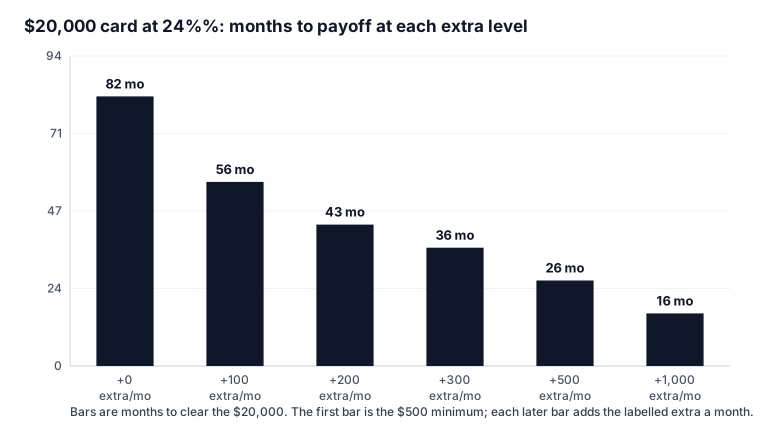
A credit card at 24% charges $400 of interest on a $20,000 balance in the first month alone. So of the $500 minimum, only $100 touches the balance — 20% of the payment. That is the trap of minimums: the payment mostly holds the lender's interest line, not your debt. Run the $500 minimum out to the end and the card clears in 82 months, having charged $20,637.97 of interest — more than the $20,000 you originally owed. The minimum is the most expensive way to pay a debt, every time.
The saving is in the second dollar. Because month 1's interest is fixed at $400 on the opening balance, sending $600 instead of $500 puts a whole extra $100 on the balance from the very first month, and that extra hundred compounds against the interest for the rest of the run. The table below shows exactly what each extra level buys.
| Extra a month | Payment | Months | Interest | Saved vs minimum | Months saved |
|---|---|---|---|---|---|
| +$0 (minimum) | $500 | 82 | $20,637.97 | $0.00 | 0 |
| +$100 | $600 | 56 | $13,288.35 | $7,349.62 | 26 |
| +$200 | $700 | 43 | $9,952.16 | $10,685.81 | 39 |
| +$300 | $800 | 36 | $8,002.25 | $12,635.72 | 46 |
| +$500 | $1,000 | 26 | $5,797.46 | $14,840.51 | 56 |
| +$1,000 | $1,500 | 16 | $3,496.79 | $17,141.18 | 66 |
What each extra level buys
The first $100 is the biggest jump: it takes 26 months off the payoff and saves $7,349.62 of interest. Each further step saves fewer months — $200 saves 39, $300 saves 46, $500 saves 56, $1,000 saves 66 — because once the balance starts falling, the interest it is charged falls with it, so later dollars have less interest left to erase. The point is not to find a magic number. The point is that the gap between the minimum and a modest extra is enormous, and the gap between a modest extra and a large one is much smaller. If you can get from the minimum to roughly double it, you have captured most of the available saving. What the extra dollar is fighting is the interest share of the payment, and that share has its own schedule: on a $5,000 card at 24% it falls from 80% of the payment to under 50% only in month 48. The size of the step matters too — the first $25 is worth twice the second on a single card.
The same extra dollar is worth far more on a high-rate debt
The extra money does the same mechanical job everywhere — it pays down balance — but it fights a different-sized interest charge. Put $20,000 at 7% instead of 24%, with a $300 minimum, and the same +$100 a month (a $400 payment) still saves 25 months but only $1,686.01 of interest. On the 24% card the same $100 saved $7,349.62 — 4.36 times as much. The calendar benefit is almost identical (26 months against 25); the interest benefit is not, because the loan was never charging what the card charges. This is why the extra should go to your highest-rate debt first: that is where each dollar is worth the most.
| Extra a month | 24% card · interest saved | 7% loan · interest saved | Card saving ÷ loan saving |
|---|---|---|---|
| +$100 | $7,349.62 | $1,686.01 | 4.36× |
| +$200 | $10,685.81 | $2,560.12 | 4.17× |
| +$300 | $12,635.72 | $3,096.20 | 4.08× |
| +$500 | $14,840.51 | $3,720.46 | 3.99× |
| +$1,000 | $17,141.18 | $4,384.74 | 3.91× |
Send the extra to the highest-rate debt first
If you carry more than one debt, the rule is simple: pay every minimum, then throw the entire extra at the single debt with the highest rate, and only move to the next debt once that one is gone. That is the avalanche method, and it is the cheapest way to clear a portfolio. The snowball method — paying the smallest balance first — is a behavioural trick that can keep you motivated, but it costs more interest because it leaves the high-rate debt accruing. Whichever you use for morale, the extra money should land on one debt at a time, not be spread a little across all of them; spreading it dilutes the effect and keeps every debt's interest running.
Reproduce these numbers
Every figure here comes from this site's public engine. Post a single balance, its rate and its minimum to /api/payoff and you get the same months and the same interest back. The card is {"balance": 20000, "apr": 24, "minPayment": 500} — with extra: 0 it returns 82 months and $20,637.97, and with extra: 100 it returns 56 months and $13,288.35. The loan is {"balance": 20000, "apr": 7, "minPayment": 300}, which returns 85 months and $5,401.35 at extra: 0 and 60 months and $3,715.34 at extra: 100. Two conventions to know: APR goes in as a percentage (24, not 0.24), and minPayment is held fixed for the whole run rather than recalculated as a percentage of the falling balance — the same convention every page on this site uses. A real card that recomputes its minimum at 2.5% of a shrinking balance would take longer and cost more than the $20,637.97 shown, not less. Or just open the calculator and type your own numbers in.
Frequently asked
How much extra should I pay on my debt each month?
As much above the minimum as you can spare — the step from the minimum to a modest extra is the single biggest win. On a $20,000 card at 24%, the $500 minimum takes 82 months and costs $20,637.97 of interest, more than you borrowed; adding $100 a month ($600) cuts that to 56 months and saves $7,349.62. Send the extra to your highest-rate debt first, because that is where each dollar saves the most.
What does the minimum payment actually do?
On the $20,000, 24% card the $500 minimum is charged $400 of interest in month 1, so only $100 reaches the balance — 20% of the payment. Run out for 82 months and the interest alone is $20,637.97, more than the original $20,000. The minimum covers the lender's charge and almost nothing else, which is why a debt on minimums feels like it never moves.
How much does an extra $100 a month save?
On the 24% card, $100 extra (a $600 payment) saves 26 months and $7,349.62 of interest. On a 7% loan the same $100 extra saves 25 months but only $1,686.01 of interest — 4.36 times less — because the lower rate is charging far less to begin with. The calendar benefit is similar; the interest benefit is not.
Should I pay the smallest debt or the highest-rate debt first?
If your goal is to pay the least interest, always send extra to the highest-rate debt (the avalanche method). Paying the smallest balance first (the snowball method) is a behaviour hack that can keep you going, but it costs more interest. Either way the extra money should go to one debt at a time, not spread thin across all of them.
Is there a point where extra money stops helping?
No — every extra dollar still shortens the loan and cuts interest — but the returns diminish. On the card, the first $100 a month takes 26 months off; the next steps take fewer months each. Doubling the payment to $1,000 (an extra $500) finishes in 26 months for $5,797.46 of interest, saving $14,840.51 against the minimum; going to $1,500 (extra $1,000) reaches 16 months and $3,496.79. Past that, you are mostly trading convenience for small interest savings.
What if I can only afford the minimum?
Then the debt runs its full term and the interest bill is at its largest. On the card that is 82 months and $20,637.97 of interest. Pay anything extra you can — even $25 or $50 a month — because the first dollars above the minimum are the ones that do the most work, and they break the cycle where the payment barely covers the interest.
Does this work the same for a loan as a credit card?
The arithmetic is identical; what changes is the rate. A 7% loan with a $300 minimum on $20,000 takes 85 months and $5,401.35 of interest at the minimum, and the same extra dollars save far less interest than on a 24% card. The lesson is the same everywhere: pay above the minimum, and aim the extra at the highest rate you carry.